- identify, Accepting, and learning how to deal with your weaknesses
- preferring that to people around you be honest with you rather than keep their negative thoughts about you to themselves
- Being yourself rather than having to pretend to be strong where you are weak
Category Archives: Learning how to learn
Five Percent Better: The Compounding of Consistent Incremental Progress
Tagged: Self-Improvement, Thought and Opinion
When we want to improve ourselves, we often pursue dramatic changes. This approach is often unsustainable. A better idea is to go for small, incremental improvements that add up over time.
***
Self-motivated, self-starting individuals are incredibly motivated to find their weaknesses. It’s not far-fetched to say that some of us actually seek to make ourselves perfect — rational, calculating beings making the right type of decisions at just the right times. But we’ve learned from Star Trek; we don’t look to eliminate emotion either and turn ourselves into Mr. Spock. We want just the right amount of emotion in our lives.
“People often overestimate what they can accomplish in one year. But they greatly underestimate what they could accomplish in five years.”
— Peter Drucker
If we’re night owls, we seek to become early risers. (Ben Franklin did it!). If we’re procrastinators, we look to become doers. If we’re always late to meetings, we look to be early to meetings. We want to eliminate our weaknesses and become a little More.
This is, of course, a laudable goal and one of the prime reasons for FS’s existence. But the self-starters among us have probably all run into the same problem: We don’t actually follow through on the things we know will make us better. We don’t eat the broccoli. We get a little too robotic. We get up at 8:30 when we said we’d do 5:30 from here on out. We leave that essay until the last second even though that was never going to happen again. We’re five minutes late. We don’t become lore at all, and the failure to get there makes us feel like less.
The culprit, I think, is the thought that any important change happens quickly. It doesn’t matter whether you’re trying to get up early or pick up and implement the Psychology of Human Misjudgment. Anything important happens pretty damn slowly.
From Potential to Useful
And why should it be otherwise? If you were to truly understand, in-depth, and apply the Psychology of Human Misjudgment to your dealings, you’d be way far out ahead of your peers and your former self. The advantage of understanding human nature is incredible. But it takes deep, repeated study and a long gestation period to get there. It takes applying the ideas to the world, feeling them out, forgetting them, re-doubling yourself, and trying again. Not giving up when you forget or fail. It is through the process of refinement that one learns new habits and ideas.
The visual mental model I like for self-improvement is imagining something like a Lathe.
A lathe, for the non-engineer, is a tool that molds a piece of material into some shapely form. A machinist would use a lathe to take a hunk of metal and turn it into a usable engine part, for example. The lathe takes something with potentialand shapes it into something useful by slowly refining it and shaving away the excess.
Compounding works in other areas besides money.
The way I think about it, if I can get 5% wiser and better every year, then I will be about twice as wise as I am now in less than 15 years. (Go ahead, grab your calculators.) In less than 30 years, my return will be 4x. This is how the non-gifted among us can surpass otherwise more intelligent people.
Small Improvements, Massive Results
Before you go off trying to figure out how one can measure such an unmeasurable thing as wisdom or usefulness, or whatever it is we’re really aiming at in the self-improvement game, let me be clear that the numbers don’t matter so much as the concept: Small improvements add up to massivedifferences. Compounding works in other areas besides money. And we want to compound worldly wisdom.
These little mental tricks like the Lathe and the idea of 5% yearly improvement are just ways to remind myself that I’m not going to wake up wiser/nicer/healthier/smarter tomorrow morning or the morning after. And just as importantly, if I backslide on a goal I’ve set or I forget something I thought I’d learned well, that it’s really not the end of the world. I don’t need to give up and call it hopeless. All I have to do is figure out where I slipped, re-double my efforts, and go after it again. All I need is 5% a year to become 4x better in my adult lifetime.
The truth is that whatever bad habits you have or whatever things you’re struggling to learn, there’s probably a good reason. Your biology and your experiences to date have set you in stone to a certain extent, and the older you are, the more likely that is to be true. The chains of habit are too light to be felt until they are too heavy to be broken. Billion-dollar industries have been built on convincing you that it’s easy to make big changes or to get a lot wiser and better. But it honestly isn’t. It’s hard work.
Yet any study of great individuals reveals that the work is worth doing.
So just imagine if you could make slightly better decisions every year. Whether it’s 5% better consideration of all of your decisions, or making 5% of your decisions differently, or some permutation thereof, it doesn’t really matter. Every year you’ll look back at some part of your old self and wonder how you could’ve been so dumb. And one day, in less than 30 years, you’ll look back and see your old self as almost unrecognizably stupid.
What more could you ask for?
Understanding your Circle of Competence: How Warren Buffett Avoids Problems
Tagged: Charlie Munger, Circle of Competence, Mental Model, Warren Buffett
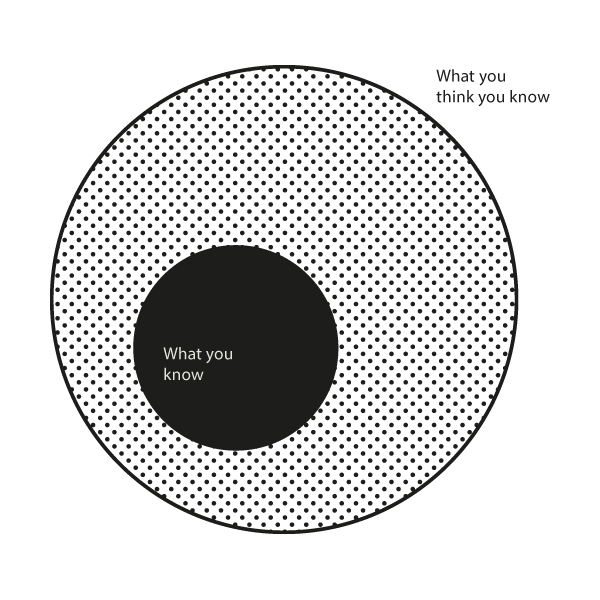
Understanding your circle of competence helps you avoid problems, identify opportunities for improvement, and learn from others.
The concept of the Circle of Competence has been used over the years by Warren Buffett as a way to focus investors on only operating in areas they knew best. The bones of the concept appear in his 1996 Shareholder Letter:
What an investor needs is the ability to correctly evaluate selected businesses. Note that word “selected”: You don’t have to be an expert on every company, or even many. You only have to be able to evaluate companies within your circle of competence. The size of that circle is not very important; knowing its boundaries, however, is vital.
Circle Of Competence
Circle of Competence is simple: Each of us, through experience or study, has built up useful knowledge on certain areas of the world. Some areas are understood by most of us, while some areas require a lot more specialty to evaluate.
For example, most of us have a basic understanding of the economics of a restaurant: You rent or buy space, spend money to outfit the place and then hire employees to seat, serve, cook, and clean. (And, if you don’t want to do it yourself, manage.)
From there, it’s a matter of generating enough traffic and setting the appropriate prices to generate a profit on the food and drinks you serve—after all of your operating expenses have been paid. Though the cuisine, atmosphere, and price points will vary by restaurant, they all have to follow the same economic formula.
That basic knowledge, along with some understanding of accounting and a little bit of study, would enable one to evaluate and invest in any number of restaurants and restaurant chains, public or private. It’s not all that complicated.
However, can most of us say we understand the workings of a microchip company or a biotech drug company at the same level? Perhaps not.
“I’m no genius. I’m smart in spots—but I stay around those spots.”
— Tom Watson Sr., Founder of IBM
But as Buffett so eloquently put it, we do not necessarily need to understand these more esoteric areas to invest capital. Far more important is to honestly define what we do know and stick to those areas. Our circle of competence can be widened, but only slowly and over time. Mistakes are most often made when straying from this discipline.
Circle of Competence applies outside of investing.
Buffett describes the circle of competence of one of his business managers, a Russian immigrant with poor English who built the largest furniture store in Nebraska:
I couldn’t have given her $200 million worth of Berkshire Hathaway stock when I bought the business because she doesn’t understand stock. She understands cash. She understands furniture. She understands real estate. She doesn’t understand stocks, so she doesn’t have anything to do with them. If you deal with Mrs. B in what I would call her circle of competence… She is going to buy 5,000 end tables this afternoon (if the price is right). She is going to buy 20 different carpets in odd lots, and everything else like that [snaps fingers] because she understands carpet. She wouldn’t buy 100 shares of General Motors if it was at 50 cents a share.
It did not hurt Mrs. B to have such a narrow area of competence. In fact, one could argue the opposite. Her rigid devotion to that area allowed her to focus. Only with that focus could she have overcome her handicaps to achieve such extreme success.
In fact, Charlie Munger takes this concept outside of business altogether and into the realm of life in general. The essential question he sought to answer: Where should we devote our limited time in life, to achieve the most success? Charlie’s simple prescription:
You have to figure out what your own aptitudes are. If you play games where other people have the aptitudes and you don’t, you’re going to lose. And that’s as close to certain as any prediction that you can make. You have to figure out where you’ve got an edge. And you’ve got to play within your own circle of competence.
If you want to be the best tennis player in the world, you may start out trying and soon find out that it’s hopeless—that other people blow right by you. However, if you want to become the best plumbing contractor in Bemidji, that is probably doable by two-thirds of you. It takes a will. It takes the intelligence. But after a while, you’d gradually know all about the plumbing business in Bemidji and master the art. That is an attainable objective, given enough discipline. And people who could never win a chess tournament or stand in center court in a respectable tennis tournament can rise quite high in life by slowly developing a circle of competence—which results partly from what they were born with and partly from what they slowly develop through work.
So, the simple takeaway here is clear. If you want to improve your odds of success in life and business, then define the perimeter of your circle of competence, and operate inside. Over time, work to expand that circle but never fool yourself about where it stands today, and never be afraid to say “I don’t know.”
“I’m no genius. I’m smart in spots—but I stay around those spots.” — Tom Watson Sr., Founder of IBM
【一天聽一點 #690】時間不夠用,是因為你沒掌握這二個重點
自從我們「一天聽一點」的頻道成立以來喔,就受到很多終身學習者的喜歡,因此呢,我也經常收到很多朋友的提問。 而最多人問到的問題就是~「我真的好想要學習,但實在沒有時間,那我該怎麼辦呢?」 事實上喔,在我的學員裡,就有很多人也有這樣的困擾,所以我有很多例子能跟你分享。 只是在我幫你拆解「時間不夠用」這個議題之前,我必須先提醒你,在這個資訊爆炸、科技快速發展的時代,能夠吸引注意力的人、事、物,本來就很多。 再加上我們日常的工作、生活,這些例行的事物,不斷主動或被動的,排進我們的行程表裡;於是喔,「時間的零碎化」就成了這個時代的必然產物。 只要你能夠認清「時間零碎化」,那是一定會發生的,那麼我們來面對「時間不夠用」的問題,才能夠找到恰當的解方。 那你一定很想知道,在時間零碎化的前提底下,到底我們可以怎麼做,讓時間足夠你使用,甚至於保持學習的習慣? 舉個例子來說,我有一個學員,他工作在台北,但為了擁有自己的家,所以選擇在桃園買房子。 雖然每天喔,要花二個小時在通勤上面,但仍然可以利用在火車、客運上面的時間,收聽我們的內容;甚至於加入「啟點線上學苑」的課程,來保持學習。 我還有一個學員,因為結了婚、生了孩子、當了媽媽之後喔,她選擇留職停薪,全心全意的在家裡照顧自己的孩子。 但她很清楚知道,自己兩年之後是要重返職場的,所以喔,格外重視持續學習的重要。 只是我們都知道,新生兒喔,每隔二、三個小時就要喝奶啊、換尿布啊、要陪伴啊,而且喔專心照顧孩子的母親,其實是很辛苦的。 所以呢,我這位女性學員她也需要休息,於是喔她的學習時間變得更破碎,不過很讓人感動的是,她還是能夠趁孩子睡著的空檔,抓緊零碎時間來幫自己進修。 你聽到這裡會不會很好奇,我們從小學讀到大學,不都是一堂課四、五十分鐘,甚至於九十分鐘不間斷。 而且呢,還常聽大人說這樣的話:「讀書啊!就是要能夠長時間的沉下心,才能夠讀得進去」;再不然就是「寫功課要一股作氣,不然很容易分心」。 所以按照道理來說,「零碎時間」只會讓人一直受到打擾,沒有辦法集中注意力;運用「零碎時間」真的能夠達成學習的效果嗎? 當然可以喔!只要你能夠掌握,接下來要跟你分享的這兩個方法。 第一個部分,就是「你要學會心智的換檔」;而第二個部分就是「你要知道自己要什麼」。 先說第一個「學會換檔」。 我要先澄清喔,這裡的換檔喔,不是要讓大家去開車,然後呢,操作車上的排檔桿,那個一般所說的手排或自排的「換檔」,不是這個喔! 我在這裡要說的是在心智上面,「專注模式」跟「發散模式」的換檔。 先簡單的說明一下,所謂的「專注模式」,在概念上是指在某段時間裡面,你可以專心一意的只做一件事。比如說,專心工作或者是全心投入學習,這種需要高度專注力的事情。 而所謂的「發散模式」,則是相對比較放鬆的狀態。像是散步啊、泡澡啊…這一類的活動。 而「換檔」就像是在你的精神或者是意念上,幫自己裝一個關開,按一下開關,你就能夠在「發散模式」跟「專注模式」之間,自由的切換。 這就像是我那位需要通勤上下班的學員,每當他下班走出公司,一直到前往火車站的這個途中,就是他處在「發散模式」。 等到他搭上火車,閉目養神五分鐘之後,他就會戴上耳機,並且把自己切換到「專注的模式」,一心一意的去投入線上課程的學習。於是呢,在他到家之前,他就能夠有所學習跟前進。 再例如喔,我那位全職媽媽的學員,她可能呢在孩子睡著的時候,她進入專注的模式,認真的學習。 而當她聽見孩子有動靜,需要她先去關注孩子的時候,她也能夠幫自己換檔,幫自己調整到相對放鬆的「發散模式」,去照顧、擁抱她的孩子。 或許喔,你會覺得這樣子一直切換,是很傷神的;就像是電器用品,每一次的開關,都是最耗電的時候。 確實,對一般人的情緒來說,最難擺脫的就是上一件事情,對於下一件事情的影響,常常會一直蔓延下去的。 但事實上,有點人生歷練你就會知道喔,能夠讓情緒適時的做切換,相互不干擾,該照顧小孩就照顧小孩,該處理事情就處理事情;這其實是一個很珍貴的能力。 因此呢,能夠真正聰明使用時間的人,必定都是「專注模式」和「發散模式」的換檔高手。 而且喔,以正式的科學研究來說,一個人最有效的專注力時間,只有十五到二十分鐘而已。 同時喔,還有研究發現,要是人長時間維持同一個姿勢都不動,像是一直坐著;其實是很容易讓腦袋產生疲倦感,反而容易發散、沒有辦法專心。 所以,因為這樣的研究結果,我們回頭想一想,是不是就很容易理解,大部份的學生為什麼在課堂上,都容易出神啊、分心啊! 因為上課時間的設計,根本不符合我們大腦運作的特性啊!也就是說,現代生活的節奏很快、訊息量很大,注意力喔太容易分散。 但如果懂得順暢的換檔,適時的在專注跟發散,這兩個模式當中切換;你就能夠整合零碎的時間,讓你更有效的完成目標。 這個部分的操作,在我的線上課程【時間駕訓班】裡,會更具體的告訴你,如何啟動「專注模式」和「發散模式」;還有怎麼樣適時的切換,才是對你最有幫助的。 不過呢,我也很清楚,對於學習「換檔」的初學者來說,相對困難的是啟動「專注模式」。 因此呢,我在這裡分享一個小秘訣喔,先教大家用最省力的方法,來啟動「專注模式」。那就是~「Next Action」,找到最簡單的下一步動作。 就像我前面提到的那兩位學員,無論他們在前一刻是在忙小孩,還是在忙工作,只要他們手上的事情告了一個段落,想進入學習的「專注模式」。 但是卻發現心還是靜不下來,那麼最不費力的小入口,就是輕輕的告訴自己「我只要聽裘老師說一分鐘」;甚至於告訴自己「我只要聽裘老師說一句話」就好。 像這種最簡單的「Next Action」下一步動作,它一旦啟動,你就會很容易不知不覺的,進入「專注模式」。 然而呢,有效的利用時間的最根本的關鍵,是我們在使用時間之前,要先「知道自己要的是什麼」? 這就像是一個不開心的人,如果他知道自己最想做的是「溜滑梯」,於是呢他花時間找到了遊樂場;因為玩耍而感覺到開心,這個結果會是他想要的,所以他花的時間就會有價值。 但如果另外一個不開心的人,他在不知道自己要的是什麼的情況下,到處亂逛;走了大半天找到了廚房,才發現食物不是他要的,他還是一樣不開心啊! 那麼對他來說,花了大半天的時間,沒有滿足自己的需要,自然就會覺得浪費時間。 所以呢,沒有先釐清自己要的是什麼,這才是現代人常常覺得「時間不夠用」的主要原因。 我也常常說喔,當一個人不知道自己要的是什麼的時候,你給他任何東西,他都不會滿意。因為他根本不知道自己要的是什麼!這是一種讓別人跟自己,都很挫折的狀態。 所以我們繼續往下看,在這個世紀初的矽谷傳奇~賈伯斯,他就曾經說過:「有時候我們決定不做的事情,會比我們決定要做的事情,來得更重要!」 時間不夠用,不是你沒有時間,而是你做了太多不需要、也不想要的事。 我想喔,無論在任何工作、生活上面的圓滿,你都必須先釐清「什麼是真心重要的關鍵?」。 你才不會把心力,浪費在不必要的地方上面,增加了自己身體的疲勞,最終還沒有創造出任何你想要的結果,白白浪費了寶貴的時間。 市面上有很多教人「效率管理」的書籍,都會要你買一本美美的行事曆,下載一個時間管理的APP,再設定兩三個鬧鐘。 但事實上,你有先釐清自己要的是什麼嗎?或者是等你忙完了這一圈,啊都已經累了,然而一切還停留在原地,徒增挫折感呢? 所以只有具備心智的「換檔」能力,再加上過程當中,不段的釐清「自己要的是什麼?」 這樣子你的意志力,才不會被錯誤的使用,否則喔,你的努力可能是餵養了「拖延」這一隻怪獸。 因為有時候我們會對生活無力,不是因為忙不過來、時間不夠用,而是你一直沒有專注在,你真正想做的事情上面。 在【時間駕訓班】我們的「第六講」內容當中,我一直提醒大家,「效率」是你使用時間方式的總和。 因此呢,我也很負責的花一整個段落的內容來告訴你,怎麼樣找出你的時間花在哪裡,並且讓你懂得該怎麼樣正確的使用時間。 同時呢,讓你對自己使用時間的模式,有更完整的認識,知道自己很容易在哪些事情上面,糾結或拖延;哪些事情可以很快的完成,該如何一一的去改善它們? 假如你還沒有參與【時間駕訓班】的學習,歡迎你加入我們的學習行列。但是如果你已經是【時間駕訓班】的成員,你的課程聽到了第幾講呢? 有任何的學習心得,都迎歡你在影片的下方留言告訴我。 啟點線上學苑的課程,都是每一個老師在生命裡,淬煉出的實用精華;並且用心的打磨,所以每個章節都有寶藏等著你去發現。 只要有任何的零碎時間,這都你最好的學習機會。這也是「啟點」推出線上課程的初衷,我們樂於為終身學習者,創造更方便的學習環境,歡迎你的加入。 無論是「一天聽一點」還是線上課程,都希望能帶給你一些啟發與幫助,我是凱宇。 如果你喜歡我製作的內容,請在影片裡按個喜歡,並且訂閱我們的頻道。別忘了訂閱旁邊的小鈴鐺,按下去;這樣子你就不會錯過我們所製作的內容。 然而如果你對於啟點文化的商品,或課程有興趣的話;我們近期的實體課程,是在12月7號開課的【寫作小學堂】。 我想很多人喔,在生命當中都有一個夢想,而這些夢想當中,有很大的一部分,可能喔都跟「創作」,而「創作」又可能跟「書寫」有關。 那不管你想要透過書寫,完成人生的什麼部分,對多數人來說,你並沒有想要成為作家,你可能只是想要透過「書寫」來圓滿自己、整理自己。 如果有機會能夠讓自己寫的東西,正確的傳達自己的想法跟信念,甚至於能夠影響一些朋友,那這會是很多人的一個期待。 【寫作小學堂】的設計初衷,就是以這個為出發點,不管你會不會成為文字工作者;甚至於你只是希望透過書寫,成為你生命當中最好的朋友。這一門課,都會回到文字跟書寫的本質。讓你透過這個途徑,更靠近你自己。 所以12月7號的【寫作小學堂】,在我錄影的這個時候,我們的名額已經到倒數了喔! 期盼你能夠把握這難得的機會,這也是我們今年,最後一期的【寫作小學堂】課程;期待你的加入,謝謝你的收看,我們再會。
“A man only learns in two ways, one by reading, and the other by association with smarter people. ” Will Roger
First Principles: Elon Musk on the Power of Thinking for Yourself
snowmobile; the challenges of TFP.
First principles thinking, which is sometimes called reasoning from first principles, is one of the most effective strategies you can employ for breaking down complicated problems and generating original solutions. It also might be the single best approach to learn how to think for yourself.
The first principles approach has been used by many great thinkers including inventor Johannes Gutenberg, military strategist John Boyd, and the ancient philosopher Aristotle, but no one embodies the philosophy of first principles thinking more effectively than entrepreneur Elon Musk.
In 2002, Musk began his quest to send the first rocket to Mars—an idea that would eventually become the aerospace company SpaceX.
He ran into a major challenge right off the bat. After visiting a number of aerospace manufacturers around the world, Musk discovered the cost of purchasing a rocket was astronomical—up to $65 million. Given the high price, he began to rethink the problem.
“I tend to approach things from a physics framework,” Musk said in an interview. “Physics teaches you to reason from first principles rather than by analogy. So I said, okay, let’s look at the first principles. What is a rocket made of? Aerospace-grade aluminum alloys, plus some titanium, copper, and carbon fiber. Then I asked, what is the value of those materials on the commodity market? It turned out that the materials cost of a rocket was around two percent of the typical price.”
Instead of buying a finished rocket for tens of millions, Musk decided to create his own company, purchase the raw materials for cheap, and build the rockets himself. SpaceX was born.
Within a few years, SpaceX had cut the price of launching a rocket by nearly 10x while still making a profit. Musk used first principles thinking to break the situation down to the fundamentals, bypass the high prices of the aerospace industry, and create a more effective solution.
First principles thinking is the act of boiling a process down to the fundamental parts that you know are true and building up from there. Let’s discuss how you can utilize first principles thinking in your life and work.
Defining First Principles Thinking
A first principle is a basic assumption that cannot be deduced any further. Over two thousand years ago, Aristotle defined a first principle as “the first basis from which a thing is known.”
First principles thinking is a fancy way of saying “think like a scientist.” Scientists don’t assume anything. They start with questions like, What are we absolutely sure is true? What has been proven?
In theory, first principles thinking requires you to dig deeper and deeper until you are left with only the foundational truths of a situation. Rene Descartes, the French philosopher and scientist, embraced this approach with a method now called Cartesian Doubt in which he would “systematically doubt everything he could possibly doubt until he was left with what he saw as purely indubitable truths.”
In practice, you don’t have to simplify every problem down to the atomic level to get the benefits of first principles thinking. You just need to go one or two levels deeper than most people. Different solutions present themselves at different layers of abstraction. John Boyd, the famous fighter pilot and military strategist, created the following thought experiment which showcases how to use first principles thinking in a practical way.
Imagine you have three things:
- A motorboat with a skier behind it
- A military tank
- A bicycle
Now, let’s break these items down into their constituent parts:
- Motorboat: motor, the hull of a boat, and a pair of skis.
- Tank: metal treads, steel armor plates, and a gun.
- Bicycle: handlebars, wheels, gears, and a seat.
What can you create from these individual parts? One option is to make a snowmobile by combining the handlebars and seat from the bike, the metal treads from the tank, and the motor and skis from the boat.
This is the process of first principles thinking in a nutshell. It is a cycle of breaking a situation down into the core pieces and then putting them all back together in a more effective way. Deconstruct then reconstruct.
How First Principles Drive Innovation
The snowmobile example also highlights another hallmark of first principles thinking, which is the combination of ideas from seemingly unrelated fields. A tank and a bicycle appear to have nothing in common, but pieces of a tank and a bicycle can be combined to develop innovations like a snowmobile.
Many of the most groundbreaking ideas in history have been a result of boiling things down to the first principles and then substituting a more effective solution for one of the key parts.
For instance, Johannes Gutenberg combined the technology of a screw press—a device used for making wine—with movable type, paper, and ink to create the printing press. Movable type had been used for centuries, but Gutenberg was the first person to consider the constituent parts of the process and adapt technology from an entirely different field to make printing far more efficient. The result was a world-changing innovation and the widespread distribution of information for the first time in history.
The best solution is not where everyone is already looking.
First principles thinking helps you to cobble together information from different disciplines to create new ideas and innovations. You start by getting to the facts. Once you have a foundation of facts, you can make a plan to improve each little piece. This process naturally leads to exploring widely for better substitutes.
The Challenge of Reasoning From First Principles
First principles thinking can be easy to describe, but quite difficult to practice. One of the primary obstacles to first principles thinking is our tendency to optimize form rather than function. The story of the suitcase provides a perfect example.
In ancient Rome, soldiers used leather messenger bags and satchels to carry food while riding across the countryside. At the same time, the Romans had many vehicles with wheels like chariots, carriages, and wagons. And yet, for thousands of years, nobody thought to combine the bag and the wheel. The first rolling suitcase wasn’t invented until 1970 when Bernard Sadow was hauling his luggage through an airport and saw a worker rolling a heavy machine on a wheeled skid.
Throughout the 1800s and 1900s, leather bags were specialized for particular uses—backpacks for school, rucksacks for hiking, suitcases for travel. Zippers were added to bags in 1938. Nylon backpacks were first sold in 1967. Despite these improvements, the form of the bag remained largely the same. Innovators spent all of their time making slight iterations on the same theme.
What looks like innovation is often an iteration of previous forms rather than an improvement of the core function. While everyone else was focused on how to build a better bag (form), Sadow considered how to store and move things more efficiently (function).
How to Think for Yourself
The human tendency for imitation is a common roadblock to first principles thinking. When most people envision the future, they project the current formforward rather than projecting the function forward and abandoning the form.
For instance, when criticizing technological progress some people ask, “Where are the flying cars?”
Here’s the thing: We have flying cars. They’re called airplanes. People who ask this question are so focused on form (a flying object that looks like a car) that they overlook the function (transportation by flight). This is what Elon Musk is referring to when he says that people often “live life by analogy.”
Be wary of the ideas you inherit. Old conventions and previous forms are often accepted without question and, once accepted, they set a boundary around creativity.
This difference is one of the key distinctions between continuous improvementand first principles thinking. Continuous improvement tends to occur within the boundary set by the original vision. By comparison, first principles thinking requires you to abandon your allegiance to previous forms and put the function front and center. What are you trying to accomplish? What is the functional outcome you are looking to achieve?
Optimize the function. Ignore the form. This is how you learn to think for yourself.
The Power of First Principles
Ironically, perhaps the best way to develop cutting-edge ideas is to start by breaking things down to the fundamentals. Even if you aren’t trying to develop innovative ideas, understanding the first principles of your field is a smart use of your time. Without a firm grasp of the basics, there is little chance of mastering the details that make the difference at elite levels of competition.
Every innovation, including the most groundbreaking ones, requires a long period of iteration and improvement. The company at the beginning of this article, SpaceX, ran many simulations, made thousands of adjustments, and required multiple trials before they figured out how to build an affordable and reusable rocket.
First principles thinking does not remove the need for continuous improvement, but it does alter the direction of improvement. Without reasoning by first principles, you spend your time making small improvements to a bicycle rather than a snowmobile. First principles thinking sets you on a different trajectory.
If you want to enhance an existing process or belief, continuous improvement is a great option. If you want to learn how to think for yourself, reasoning from first principles is one of the best ways to do it.
Footnotes
- When Musk originally looked into hiring another firm to send a rocket from Earth to Mars, he was quoted prices as high as $65 million. He also traveled to Russia to see if he could buy an intercontinental ballistic missile (ICBM), which could then be retrofitted for space flight. It was cheaper, but still in the $8 million to $20 million range.
- “Elon Musk’s Mission to Mars,” Chris Anderson, Wired.
- “SpaceX and Daring to Think Big,” Steve Jurvetson. January 28, 2015.
- “The Metaphysics,” Aristotle, 1013a14–15
- Wikipedia article on first principles
- I originally found the snowmobile example in The OODA Loop: How to Turn Uncertainty Into Opportunity by Taylor Pearson.
- Story from “Where Good Ideas Come From,” Steven Johnson
- Story from “Reinventing the Suitcase by Adding the Wheel,” Joe Sharkey, The New York Times
- “A Brief History of the Modern Backpack,” Elizabeth King, Time
- Hat tip to Benedict Evans for his tweets that inspired this example.
- Stereotypes fall into this style of thinking. “Oh, I once knew a poor person who was dumb, so all poor people must be dumb.” And so on. Anytime we judge someone by their group status rather than their individual characteristics we are reasoning about them by analogy.
How Do You Learn How To Learn? Learn From Learners

Are you learning as fast as the world is changing? A constant state of change requires a constant state of learning. Only a handful of companies, and people, cultivate learning as a skill.
Put simply:
Cultures of innovation = Cultures of learning
With that said, there is one skill that will always be relevant in the future: continuous learning.
There is a dominant belief that learning stops once you put your diploma to use and get a job. Wrong! Learning is a skill that can be improved, and it never stops.
So, how do you learn how to learn?
Learn From Learners
Sound simple, right? Here’s the thing, there are ways to learn faster and better than how one is taught throughout school.
From Chris McCann’s class notes from Class 18 of Stanford University’s CS183C — Technology-enabled Blitzscaling — taught by Reid Hoffman, John Lilly, Chris Yeh, and Allen Blue. This class was an interview by Reid Hoffman of Brian Chesky — the founder and CEO of Airbnb.
This is Brian’s response on an audience question about learning how to learn:
I don’t have all the answers but here’s a tip.
If I was to ask you to learn about a topic in a week ex. the basics of UI design — how would you do it?
Read a ton of books, talk to people, do exercises? This is a fairly exhaustive process but you could do it.
Now what if I said in the same week you have to learn UI design, front end development, accounting, and how to incorporate a company — how would you do it?
There isn’t enough hours in the day to learn everything. So you have to short circuit the process somehow.
One approach is to learn from definitive sources. The downside is, if you pick the wrong source, you learn the wrong thing; however, if you pick the right source, you don’t have to read anything else.
For example with management I read High Output Management. I just read one book so I don’t need to read anything else about management. Paul Grahamwas a version of this at Y Combinator and he would point us to the resources that mattered.
One benefit of being more successful is you have access to talk to more successful people. But even before being successful, you can read about the best people.
Another tip is most people will help you if you ask a question — we are here to share information and knowledge. I was shameless in asking Reid Hoffman questions — I was probably annoying but I didn’t care — I just wanted to learn.
My own method for learning varies, but right off the bat I develop a list of questions about a topic, ask people in the know, and immerse myself in the topic. I also read lots of biographies of interesting people; my goal is to understand how they think and then add that to my cognitive toolbox.
Hack Learning By Breaking It Down
Some people have even hacked the learning process. For example, Tim Ferrisshas made his name from hacking fitness and cooking. In doing so he identified a process for quickly mastering any skill, which he shares in a talk:
Ferriss has taken his method a step further, and also has a well known podcast where he interviews interesting people who share their own approach to how they learn.
Similar to Ferris, Josh Kaufman has taken a similar approach to hack learning:
Put Yourself In The Context Of What You Want To Learn
Learning how others learn isn’t the only way to understand a topic quickly, putting yourself in the context of what you want to learn is another approach.
For example, my buddy Ivan, who I recently had on the podcast to discuss the ethics of artificial intelligence, is a self-taught programmer. How did he do it? He started hanging out with other programmers and got involved in their projects; and then coded is own projects.
It took him time, but that’s what it takes.
Start From The Basics
Another well known innovator who learns quickly is Elon Musk.
How does he do it?
He learns the foundations and then moves from there.
Here’s what Elon responded to a question on Reddit AMA about how he learns so much so fast:
I think most people can learn a lot more than they think they can. They sell themselves short without trying.
One bit of advice: it is important to view knowledge as sort of a semantic tree — make sure you understand the fundamental principles, ie the trunk and big branches, before you get into the leaves/details or there is nothing for them to hang on to.
Interestingly, as I’ve written about before, starting from first principles is an effective approach to innovation.
Leaders Are Learners
Great leaders simply aren’t satisfied with what they know. They possess an insatiable curiosity for discovery and learning – they are in constant pursuit of what they don’t know.
That’s why the best and most innovative leaders are pattern thinkers, that is they are intensely and endlessly curious. They all have that in common, the skills necessary to innovate: ask questions, pay attention, seek and talk to interesting people and lastly, experiment with ideas.
Bottom line: When we stop learning we stop growing. Continuous learning is a life skill, an antidote to irrelevance. So teaching yourself to master any skill is a powerful investment in yourself.
The “Thinking” in Systems Thinking: How Can We Make It Easier to Master?
Despite significant advances in personal computers and systems thinking software over the last decade, learning to apply systems thinking effectively remains a tough nut to crack. Many intelligent people continue to struggle far too long with the systems thinking paradigm, thinking process, and methodology.
From my work with both business and education professionals over the last 15 years, I have come to believe that systems thinking’s steep learning curve is related to the fact that the discipline requires mastering a whole package of thinking skills.
STEPS IN THE SYSTEMS THINKING METHOD
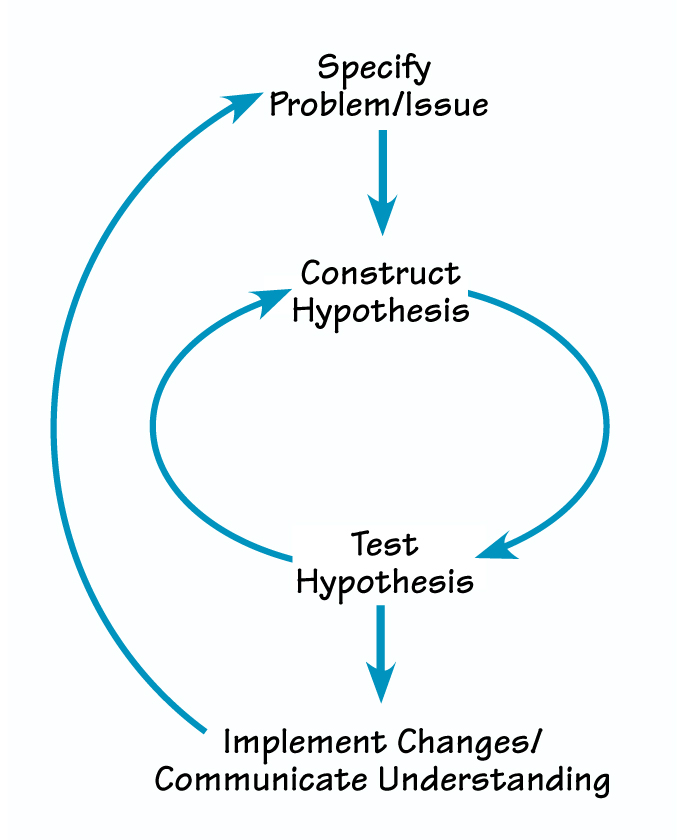
Begin by specifying the problem you want to address. Then construct hypotheses to explain the problem and test them using models. Only when you have a sufficient understanding of the situation should you begin to implement change.
Much like the accomplished basketball player who is unaware of the many separate skills needed to execute a lay-up under game conditions – such as dribbling while running and without looking at the ball, timing and positioning the take-off, extending the ball toward the rim with one hand while avoiding the blocking efforts of defenders – veteran systems thinkers are unaware of the full set of thinking skills that they deploy while executing their craft. By identifying these separate competencies, both new hoop legends and systems thinking wannabes can practice each skill in isolation. This approach can help you master each of the skills before you try to put them all together in an actual game situation.
The Systems Thinking Method
Before exploring these critical thinking skills, it’s important to have a clear picture of the iterative, four-step process used in applying systems thinking (see “Steps in the Systems Thinking Method”). In using this approach, you first specify the problem or issue you wish to explore or resolve. You then begin to construct hypotheses to explain the problem and test them using models whether mental models, pencil and paper models, or computer simulation models. When you are content that you have developed a workable hypothesis, you can then communicate your new found clarity to others and begin to implement change.
When we use the term “models” in this article, we are referring to something that represents a specifically defined set of assumptions about how the world works. We start from a premise that all models are wrong because they are incomplete representations of reality, but that some models are more useful than others (they help us understand reality better than others). There is a tendency in the business world, however, to view models (especially computer-based models) as “answer generators;” we plug in a bunch of numbers and get out a set of answers. From a systems thinking perspective, however, we view models more as “assumptions and theory testers” we formulate our understanding and then rigorously test it. The bottom line is that all models are only as good as the quality of the thinking that went into creating them. Systems thinking, and its ensemble of seven critical thinking skills, plays an important role in improving the quality of our thinking.
The Seven Critical Thinking Skills
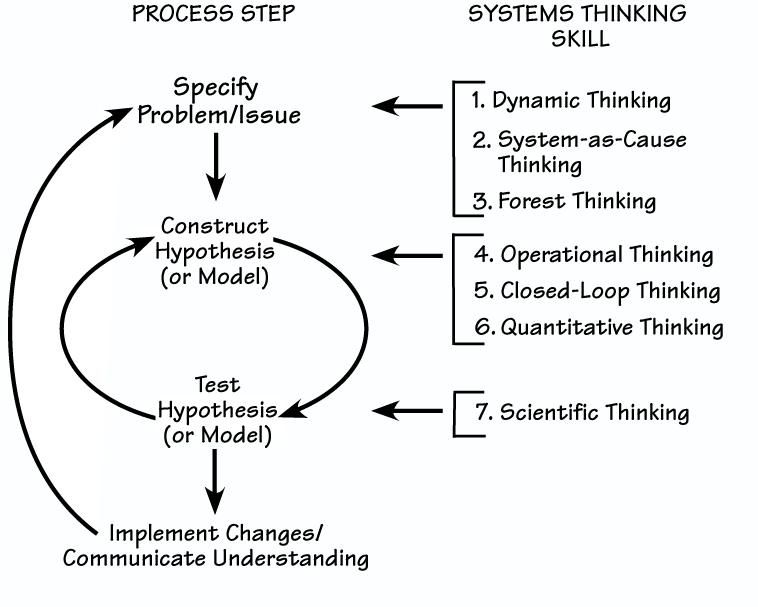
As you undertake a systems thinking process, you will find that the use of certain skills predominates in each step. I believe there are at least seven separate but interdependent thinking skills that seasoned systems thinkers master. The seven unfold in the following sequence when you apply a systems thinking approach: Dynamic Thinking, System-as-Cause Thinking, Forest Thinking, Operational Thinking, Closed-Loop Thinking, Quantitative Thinking, and Scientific Thinking.
The first of these skills, Dynamic Thinking, helps you define the problem you want to tackle.
The next two, System-as-Cause Thinking and Forest Thinking, are invaluable in helping you to determine what aspects of the problem to include, and how detailed to be in representing each.
The fourth through sixth skills, Operational Thinking, Closed-Loop Thinking, and Quantitative Thinking, are vital for representing the hypotheses (or mental models) that you are going to test.
The final skill, Scientific Thinking, is useful in testing your models.
Each of these critical thinking skills serves a different purpose and brings something unique to a systems thinking analysis. Let’s explore these skills, identify how you can develop them, and determine what their “non-systems thinking” counterparts (which dominate in traditional thinking) look like.
Dynamic Thinking: Dynamic Thinking is essential for framing a problem or issue in terms of a pattern of behavior over time. Dynamic Thinking contrasts with Static Thinking, which leads people to focus on particular events. Problems or issues that unfold over time as opposed to one-time occurrences are most suitable for a systems thinking approach.
You can strengthen your Dynamic Thinking skills by practicing constructing graphs of behavior overtime. For example, take the columns of data in your company’s annual report and graph a few of the key variables over time. Divide one key variable by another (such as revenue or profit by number of employees), and then graph the results. Or pick up today’s news-paper and scan the head-lines for any attention-grabbing events. Then think about how you might see those events as merely one interesting point in a variable’s overall trajectory over time. The next time someone suggests that doing this-and-that will fix such-and-such, ask, “Over what time frame? How long will it take? What will happen to key variables over time?”
System-as-Cause Thinking: Dynamic Thinking positions your issue as a pattern of behavior over time. The next step is to construct a model to explain how the behavior arises, and then suggest ways to improve that behavior. System-as-Cause Thinking can help you determine the extensive boundary of your model, that is, what to include in your model and what to leave out (see “Extensive and Intensive Model Boundaries”). From a System-as-Cause Thinking approach, you should include only the elements and inter-relationships that are within the control of managers in the system and are capable of generating the behavior you seek to explain.
By contrast, the more common System-as-Effect Thinking views behavior generated by a system as “driven” by external forces. This perspective can lead you to include more variables in your model than are really necessary. System-as-Cause Thinking thus focuses your model more sharply, because it places the responsibility for the behavior on those who manage the policies and plumbing of the system itself.
To develop System-as-Cause Thinking, try turning each “They did it” or “It’s their fault” you encounter into a “How could we have been responsible?” It is always possible to see a situation as caused by “outside forces.” But it is also always possible to ask, “What did we do to make ourselves vulnerable to those forces that we could not control?”
EXTENSIVE AND INTENSIVE MODEL BOUNDARIES
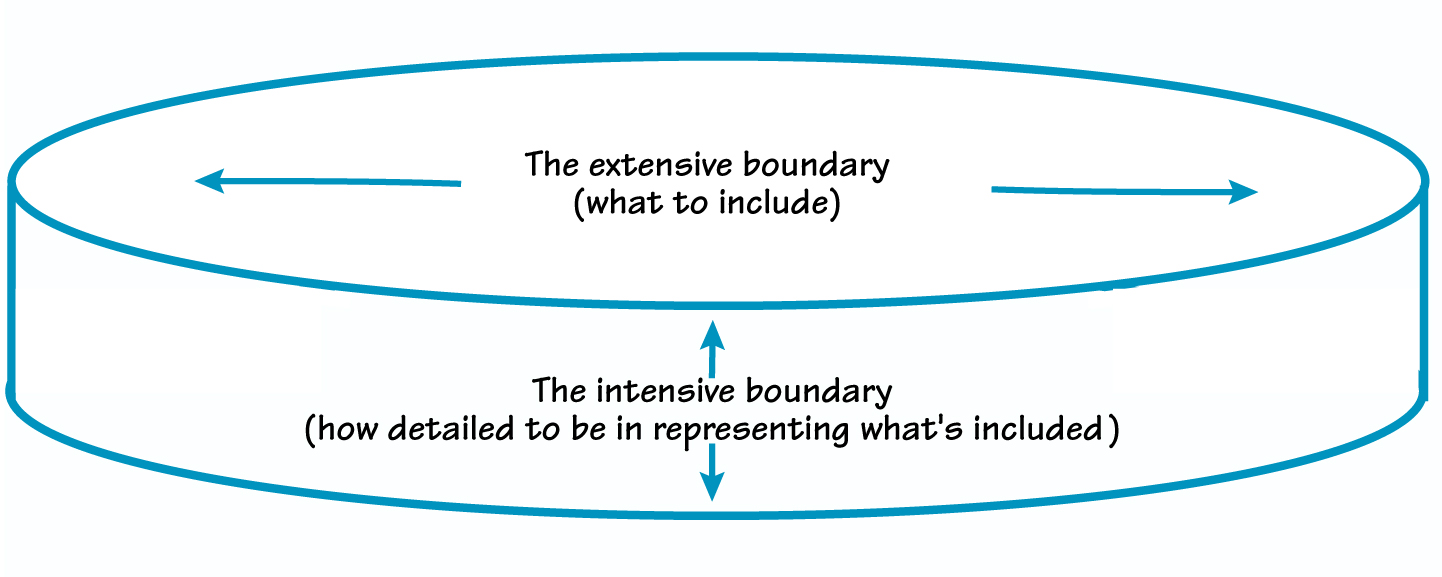
Forest Thinking: In many organizations, people assume that to really know something, they must focus on the details. This assumption is reinforced by day-to-day existence—we experience life as a sequence of detailed events. We can also think of this as Tree-by-Tree Thinking. Models that we create by applying Tree-by-Tree Thinking tend to be large and overly detailed; their intensive boundaries run deep. In using such models, we would want to know whether that particular red truck broke down on Tuesday before noon, as opposed to being interested in how frequently, on average, trucks break down. Forest Thinking–inspired models, by contrast, group the details to give us an “on average” picture of the system. To hone your Forest Thinking skills, practice focusing on similarities rather than differences. For example, although everyone in your organization is unique, each also shares some characteristics with others. While some are highly motivated to perform and others are not, all have the potential to make a contribution. Regardless of the individual, realizing potential within an organization comes from the same generic structure. For example, what is the relationship among factors that tends to govern an individual’s motivation?
Operational Thinking :Operational Thinking tries to get at causality—how is behavior actually generated? This thinking skill contrasts with Correlational or Factors Thinking. Steven Covey’s The Seven Habits of Highly Effective People, one of the most popular nonfiction books of all time, is a product of Factors Thinking. So are the multitude of lists of “Critical Success Factors” or “Key Drivers of the Business” that decorate the office walls (and mental models) of so many senior executives. We like to think in terms of lists of factors that influence or drive some result.
There are several problems with mental models bearing such list structures, however. For one thing, lists do not explain how each causal factor actually works its magic. They merely imply that each factor “influences,” or is “correlated with,” the corresponding result. But influence or correlation is not the same as causality.
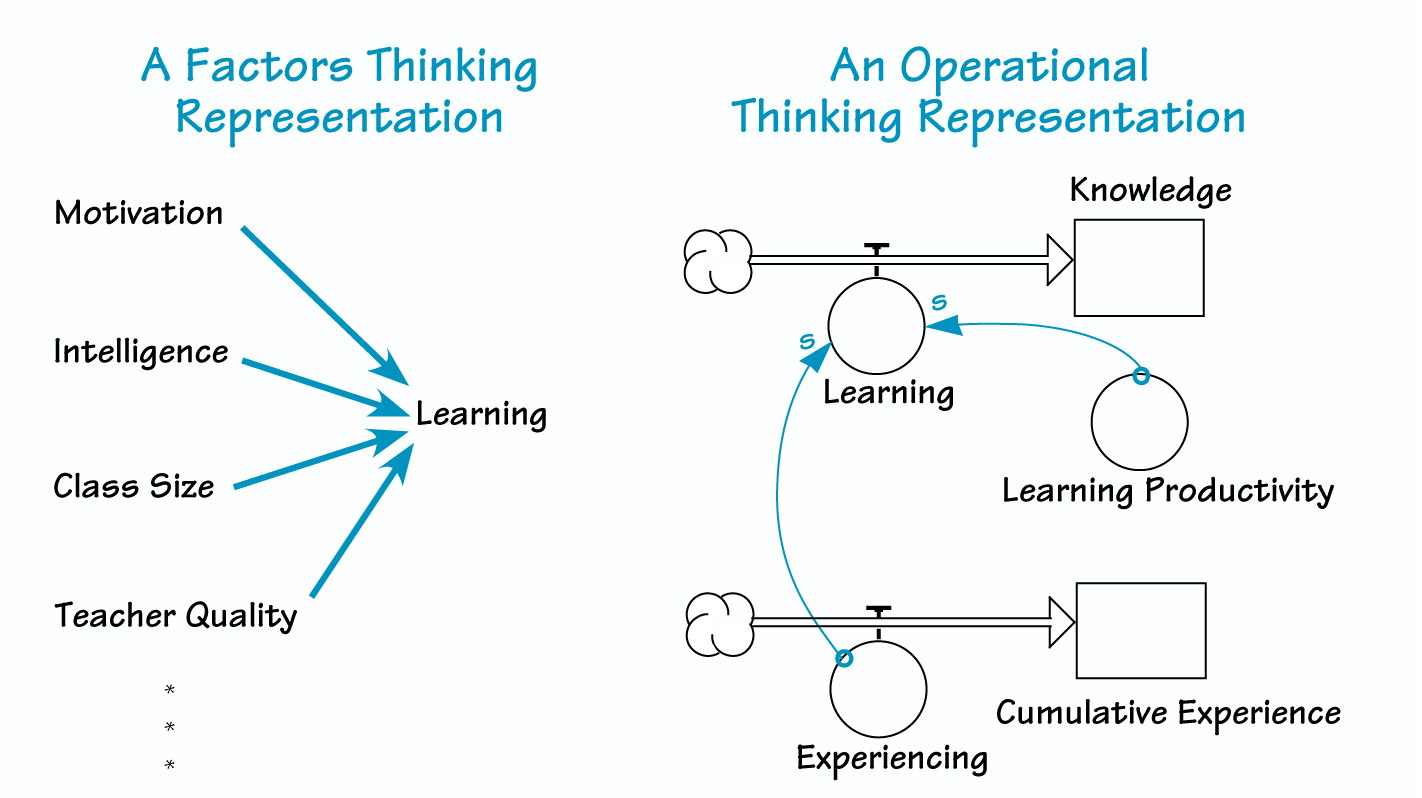
For example, if you use Factors Thinking to analyze what influences learning, you can easily come up with a whole “laundry list” of factors (see “Two Representations of the Learning Process”). But if you use Operational Thinking, you might depict learning as a process that coincides with the building of experience. Operational Thinking captures the nature of the learning process by describing its structure, while Factors Thinking merely enumerates a set of factors that in some way “influence” the process.
To develop your Operational Thinking skills, you need to work your way through various activities that define how a business works examine phenomena such as hiring, producing, learning, motivating, quitting, and setting price. In each case, ask, “What is the nature of the process at work?” as opposed to “What are all of the factors that influence the process?”
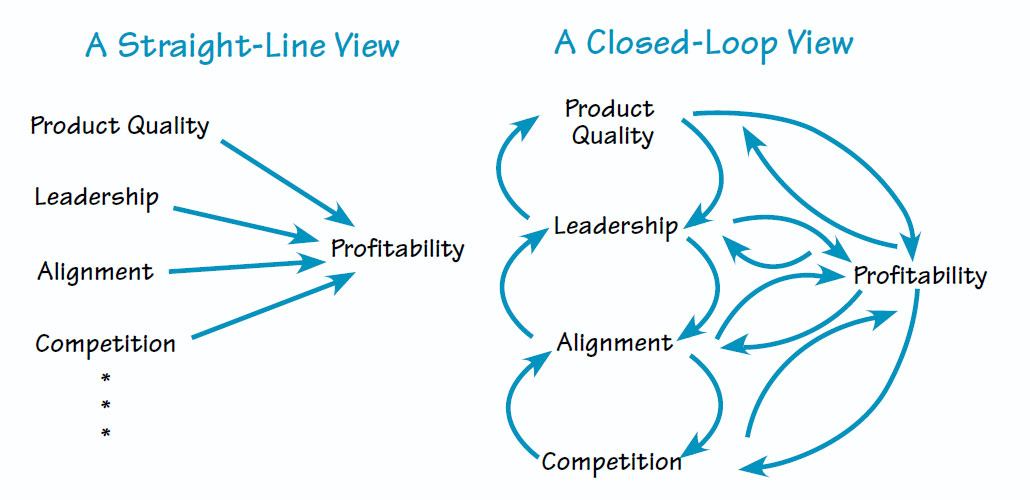
Closed-Loop Thinking :Imagine discussing your company’s profitability situation with some of your coworkers. In most companies, the group would likely list things such as product quality, leadership, or competition as influences on profitability (see “A Straight-Line vs. a Closed-Loop View of Causality”). This tendency to list factors stems from Straight-Line Thinking. The assumptions behind this way of thinking are 1) that causality runs only one way—from “this set of causes” to “that effect,” and 2) that each cause is independent of all other causes. In reality, however, as the closed-loop part of the illustration shows, the “effect” usually feeds back to influence one or more of the “causes,” and the causes themselves affect each other. Closed-Loop Thinking skills therefore lead you to see causality as an ongoing process, rather than a one-time event.
To sharpen your Closed-Loop Thinking skills, take any laundry list that you encounter and think through the ways in which the driven drives and in which the drivers drive each other. Instead of viewing one variable as the most important driver and another one as the second most important, seek to understand how the dominance among the variables might shift over time.
TWO REPRESENTATIONS OF THE LEARNING PROCESS
Quantitative Thinking: In this phrase, “quantitative” is not synonymous with “measurable.” The two terms are often confused in practice, perhaps because of the presumption in the Western scientific world that “to know, one must measure precisely.” Although Heisenberg’s Uncertainty Principle caused physicists to back off a bit in their quest for numerical exactitude, business folk continue unabated in their search for perfectly measured data. There are many instances of analysis getting bogged down because of an obsession with “getting the numbers right.” Measurement Thinking continues to dominate!
There are a whole lot of things, however, that we will never be able to measure very precisely. These include “squishy,” or “soft,” variables, such as motivation, self-esteem, commitment, and resistance to change. Many so-called “hard” variables are also difficult to measure accurately, given the speed of change and the delays and imperfections in information systems.
A STRAIGHT-LINE VS.A CLOSED-LOOP VIEW OF CAUSALITY
But let’s return to our “squishy” variables. Would anyone want to argue that an employee’s self-esteem is irrelevant to her performance? Who would propose that commitment is unimportant to a company’s success? Although few of us would subscribe to either argument, things like self-esteem and commitment rarely make it into the spreadsheets and other analytical tools that we use to drive analysis. Why? Because such variables can’t be measured. However, they can be quantified. If zero means a total absence of commitment, 100 means being as committed as possible. Are these numbers arbitrary? Yes. But are they ambiguous? Absolutely not! If you want your model to shed light on how to increase strength of commitment as opposed to predicting what value commitment will take on in the third-quarter of 1997—you can include strength of commitment as a variable with no apologies. You can always quantify, though you can’t always measure.
To improve your Quantitative Thinking skills, take any analysis that your company has crunched through over the last year and ask what key “soft” variables were omitted, such as employee motivation. Then, ruminate about the possible implications of including them systems thinking gives you the power to ascribe full-citizen status to such variables. You’ll give up the ability to achieve perfect measurement. But if you’re honest, you’ll see that you never really had that anyway.
Scientific Thinking: The final systems thinking skill is Scientific Thinking. I call its opposite Proving Truth Thinking. To understand Scientific Thinking, it is important to acknowledge that progress in science is measured by the discarding of falsehoods. The current prevailing wisdom is always regarded as merely an “entertainable hypothesis,” just waiting to be thrown out the window. On the other hand, too many business models are unscientific; yet business leaders revere them as truth and defend them to the death. Analysts make unrelenting efforts to show that their models track history and therefore must be “true.”
Seasoned systems thinkers continually resist the pressure to “validate” their models (that is, prove truth) by tracking history. Instead, they work hard to become aware of the falsehoods in their models and to communicate these to their team or clients. “All models are wrong,”” said W. Edwards Deming. “Some models are useful.” Deming was a smart guy, and clearly a systems thinker.
In using Scientific Thinking, systems thinkers worry less about outfitting their models with exact numbers and instead focus on choosing numbers that are simple, easy to understand, and make sense relative to one another. Systems thinkers also pay lots of attention to robustness they torture-test their models to death! They want to know under what circumstances their model “breaks down.” They also want to know, does it break down in a realistic fashion? What are the limits to my confidence that this model will be useful?
The easiest way to sharpen your Scientific Thinking skills is to start with a computer model that is “in balance” and then shock it. For example, transfer 90% of the sales force into manufacturing. Set price at 10 times competitor price. Triple the customer base in an instant. Then see how the model performs. Not only will you learn a lot about the range of utility of the model, but you also will likely gain insight into the location of that most holy of grails: high-leverage intervention points.
A Divide and Conquer Strategy
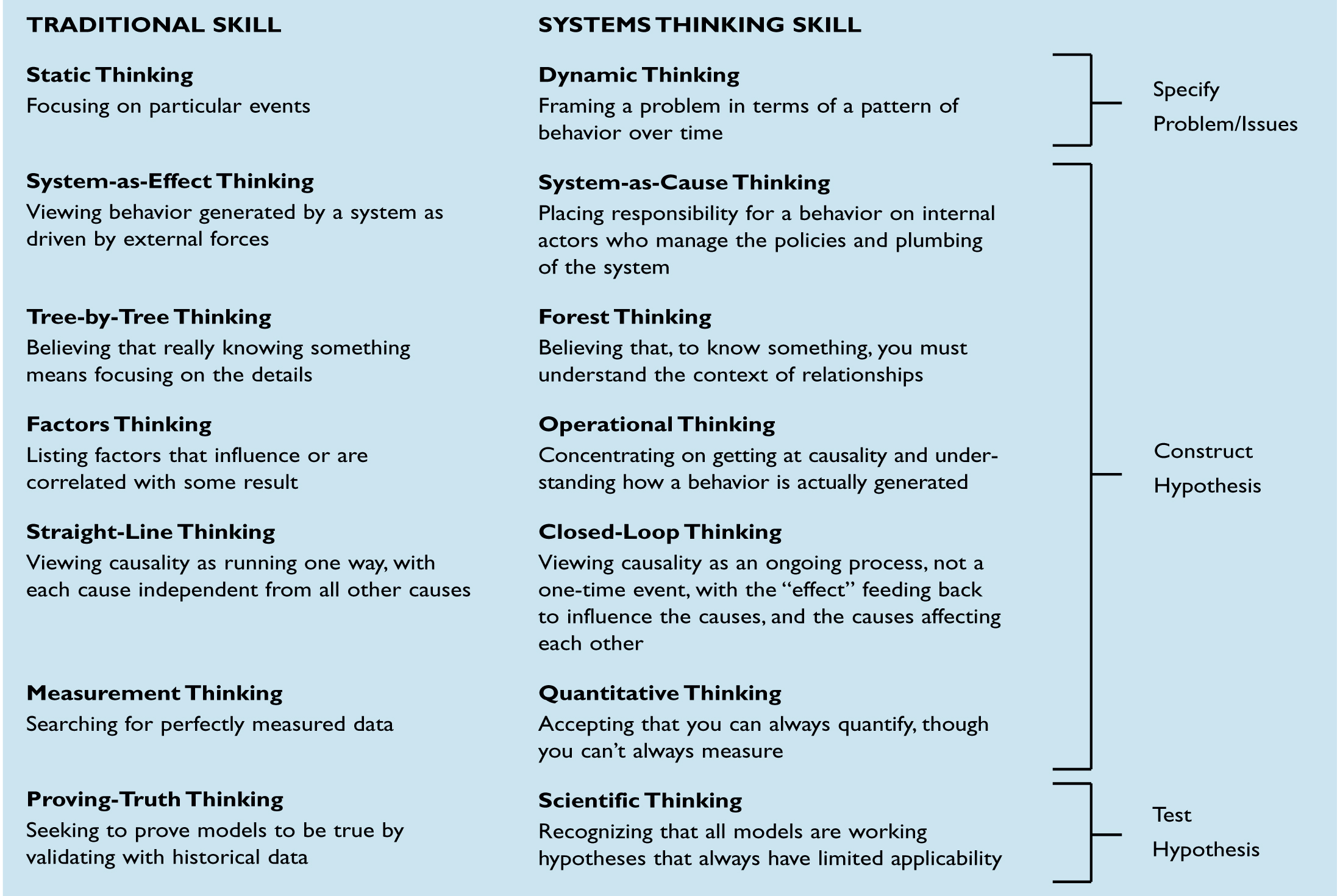
As the success of Peter Senge’s The Fifth Discipline: The Art & Practice of the Learning Organization has shown, systems thinking is both sexy and seductive. But applying it effectively is not so easy. One reason for this difficulty is that the thinking skills needed to do so are many in number and stand in stark contrast to the skill set that most of us currently use when we grapple with business issues (see “Traditional Business Thinking vs. Systems Thinking Skills”).
By separating and examining the seven skills required to apply systems thinking effectively, you can practice them one at a time. If you master the individual skills first, you stand a much better chance of being able to put them together in a game situation. So, practice . . . then take it to the hoop!
“Barry Richmond is the managing director and founder of High Performance Systems, Inc. He has a PhD in system dynamics from the MIT Sloan School of Management, an MS from Case Western Reserve, and an MBA from Columbia University”
TRADITIONAL BUSINESS THINKING VS. SYSTEMS THINKING SKILLS
Elon Musks’ “3-Step” First Principles Thinking: How to Think and Solve Difficult Problems Like a Genius

By the age of 46 years old, Elon Musk has innovated and built three revolutionary multibillion dollar companies in completely different fields — Paypal (Financial Services), Tesla Motors (Automotive) and SpaceX (Aerospace).
This list doesn’t even include Solar City (Energy), which he helped build and acquired for $2.6 Billion recently.
At first glance, it’s easy to link his rapid success, ability to solve unsolvable problems and genius level creativity to his incredible work ethic.
Musk himself stated that he worked approximately 100 hours a week for over 15 years and recently scaled down to 85 hours. Rumour also has it that he doesn’t even take lunch breaks, multitasking between eating, meetings and responding to emails all at the same time.
No doubt work ethic plays an important role in unlocking your inner creative genius and becoming the best at what you do — but there’s more to this — there are extremely hard-working people who still make little progress in life and die before sharing their best work with the world.
What then is this missing link for innovative creativity and accelerated success?
Just like Musk, some of the most brilliant minds of all-time — Aristotle, Euclid, Thomas Edison, Feynman and Nikola Tesla — use this missing link for accelerated learning, solving difficult problems and creating great work in their lifetime.
This missing link has little to do with how hard they work. It has everything to do with how they think.
Let’s talk about how you can quickly use this genius problem solving method.
First Principles Thinking
During a one on one interview with TED Curator, Chris Anderson, Musk reveals this missing link which he attributes to his genius level creativity and success. It’s called reasoning from “First Principles.” [1]
Musk: Well, I do think there’s a good framework for thinking. It is physics. You know, the sort of first principles reasoning. Generally I think there are — what I mean by that is, boil things down to their fundamental truths and reason up from there, as opposed to reasoning by analogy.
Through most of our life, we get through life by reasoning by analogy, which essentially means copying what other people do with slight variations.
In layman’s terms, first principles thinking is basically the practice of actively questioning every assumption you think you ‘know’ about a given problem or scenario — and then creating new knowledge and solutions from scratch. Almost like a newborn baby.
On the flip side, reasoning by analogy is building knowledge and solving problems based on prior assumptions, beliefs and widely held ‘best practices’ approved by majority of people.
People who reason by analogy tend to make bad decisions, even if they’re smart.

FOOTNOTES
- In this interview, Musk talks about this 100 hour work week. This is his interview on TED about first principles thinking.
- Musk gave this answer to a question from a reader asking him how he learns so fast. (source)
- Musk’s interview with Kevin Rose on first principles thinking and battery analogy.
- This is not always easy. In fact, sometimes it can be a tough mental workout to use first principles thinking simply because it’s much easier to default back to what you already ‘know.’ Because of our prior assumptions and limiting beliefs, we have a tendency to only think of a very limited range of creative uses or solutions to any given problem. This is more formally known as “functional fixedness”.Dr.Tony McCaffery, Cognitive Psychologist and Innovation expert, has developed a simple method that can help us overcome this tendency and uncover creative solutions. You can read about his “general parts technique” here.
- Thanks to peter at renaissance man journal for some inspiring insights on first principles thinking.
 World/JasonSiu/Mind