Understanding your Circle of Competence: How Warren Buffett Avoids Problems

Tagged: Charlie MungerCircle of CompetenceMental ModelWarren Buffett

(c)2018 Farnam Street Media Inc. May not be used without permission.

Understanding your circle of competence helps you avoid problems, identify opportunities for improvement, and learn from others.

The concept of the Circle of Competence has been used over the years by Warren Buffett as a way to focus investors on only operating in areas they knew best. The bones of the concept appear in his 1996 Shareholder Letter:

What an investor needs is the ability to correctly evaluate selected businesses. Note that word “selected”: You don’t have to be an expert on every company, or even many. You only have to be able to evaluate companies within your circle of competence. The size of that circle is not very important; knowing its boundaries, however, is vital.

Circle Of Competence

Circle of Competence is simple: Each of us, through experience or study, has built up useful knowledge on certain areas of the world. Some areas are understood by most of us, while some areas require a lot more specialty to evaluate.

For example, most of us have a basic understanding of the economics of a restaurant: You rent or buy space, spend money to outfit the place and then hire employees to seat, serve, cook, and clean. (And, if you don’t want to do it yourself, manage.)

From there, it’s a matter of generating enough traffic and setting the appropriate prices to generate a profit on the food and drinks you serve—after all of your operating expenses have been paid. Though the cuisine, atmosphere, and price points will vary by restaurant, they all have to follow the same economic formula.

That basic knowledge, along with some understanding of accounting and a little bit of study, would enable one to evaluate and invest in any number of restaurants and restaurant chains, public or private. It’s not all that complicated.

However, can most of us say we understand the workings of a microchip company or a biotech drug company at the same level? Perhaps not.

“I’m no genius. I’m smart in spots—but I stay around those spots.”

— Tom Watson Sr., Founder of IBM

But as Buffett so eloquently put it, we do not necessarily need to understand these more esoteric areas to invest capital. Far more important is to honestly define what we do know and stick to those areas. Our circle of competence can be widened, but only slowly and over time. Mistakes are most often made when straying from this discipline.

Circle of Competence applies outside of investing.

Buffett describes the circle of competence of one of his business managers, a Russian immigrant with poor English who built the largest furniture store in Nebraska:

I couldn’t have given her $200 million worth of Berkshire Hathaway stock when I bought the business because she doesn’t understand stock. She understands cash. She understands furniture. She understands real estate. She doesn’t understand stocks, so she doesn’t have anything to do with them. If you deal with Mrs. B in what I would call her circle of competence… She is going to buy 5,000 end tables this afternoon (if the price is right). She is going to buy 20 different carpets in odd lots, and everything else like that [snaps fingers] because she understands carpet. She wouldn’t buy 100 shares of General Motors if it was at 50 cents a share.

It did not hurt Mrs. B to have such a narrow area of competence. In fact, one could argue the opposite. Her rigid devotion to that area allowed her to focus. Only with that focus could she have overcome her handicaps to achieve such extreme success.

In fact, Charlie Munger takes this concept outside of business altogether and into the realm of life in general. The essential question he sought to answer: Where should we devote our limited time in life, to achieve the most success? Charlie’s simple prescription:

You have to figure out what your own aptitudes are. If you play games where other people have the aptitudes and you don’t, you’re going to lose. And that’s as close to certain as any prediction that you can make. You have to figure out where you’ve got an edge. And you’ve got to play within your own circle of competence.

If you want to be the best tennis player in the world, you may start out trying and soon find out that it’s hopeless—that other people blow right by you. However, if you want to become the best plumbing contractor in Bemidji, that is probably doable by two-thirds of you. It takes a will. It takes the intelligence. But after a while, you’d gradually know all about the plumbing business in Bemidji and master the art. That is an attainable objective, given enough discipline. And people who could never win a chess tournament or stand in center court in a respectable tennis tournament can rise quite high in life by slowly developing a circle of competence—which results partly from what they were born with and partly from what they slowly develop through work.

So, the simple takeaway here is clear. If you want to improve your odds of success in life and business, then define the perimeter of your circle of competence, and operate inside. Over time, work to expand that circle but never fool yourself about where it stands today, and never be afraid to say “I don’t know.”

【一天聽一點 #690】時間不夠用,是因為你沒掌握這二個重點

自從我們「一天聽一點」的頻道成立以來喔,就受到很多終身學習者的喜歡,因此呢,我也經常收到很多朋友的提問。 而最多人問到的問題就是~「我真的好想要學習,但實在沒有時間,那我該怎麼辦呢?」 事實上喔,在我的學員裡,就有很多人也有這樣的困擾,所以我有很多例子能跟你分享。 只是在我幫你拆解「時間不夠用」這個議題之前,我必須先提醒你,在這個資訊爆炸、科技快速發展的時代,能夠吸引注意力的人、事、物,本來就很多。 再加上我們日常的工作、生活,這些例行的事物,不斷主動或被動的,排進我們的行程表裡;於是喔,「時間的零碎化」就成了這個時代的必然產物。 只要你能夠認清「時間零碎化」,那是一定會發生的,那麼我們來面對「時間不夠用」的問題,才能夠找到恰當的解方。 那你一定很想知道,在時間零碎化的前提底下,到底我們可以怎麼做,讓時間足夠你使用,甚至於保持學習的習慣? 舉個例子來說,我有一個學員,他工作在台北,但為了擁有自己的家,所以選擇在桃園買房子。 雖然每天喔,要花二個小時在通勤上面,但仍然可以利用在火車、客運上面的時間,收聽我們的內容;甚至於加入「啟點線上學苑」的課程,來保持學習。 我還有一個學員,因為結了婚、生了孩子、當了媽媽之後喔,她選擇留職停薪,全心全意的在家裡照顧自己的孩子。 但她很清楚知道,自己兩年之後是要重返職場的,所以喔,格外重視持續學習的重要。 只是我們都知道,新生兒喔,每隔二、三個小時就要喝奶啊、換尿布啊、要陪伴啊,而且喔專心照顧孩子的母親,其實是很辛苦的。 所以呢,我這位女性學員她也需要休息,於是喔她的學習時間變得更破碎,不過很讓人感動的是,她還是能夠趁孩子睡著的空檔,抓緊零碎時間來幫自己進修。 你聽到這裡會不會很好奇,我們從小學讀到大學,不都是一堂課四、五十分鐘,甚至於九十分鐘不間斷。 而且呢,還常聽大人說這樣的話:「讀書啊!就是要能夠長時間的沉下心,才能夠讀得進去」;再不然就是「寫功課要一股作氣,不然很容易分心」。 所以按照道理來說,「零碎時間」只會讓人一直受到打擾,沒有辦法集中注意力;運用「零碎時間」真的能夠達成學習的效果嗎? 當然可以喔!只要你能夠掌握,接下來要跟你分享的這兩個方法。 第一個部分,就是「你要學會心智的換檔」;而第二個部分就是「你要知道自己要什麼」。 先說第一個「學會換檔」。 我要先澄清喔,這裡的換檔喔,不是要讓大家去開車,然後呢,操作車上的排檔桿,那個一般所說的手排或自排的「換檔」,不是這個喔! 我在這裡要說的是在心智上面,「專注模式」跟「發散模式」的換檔。 先簡單的說明一下,所謂的「專注模式」,在概念上是指在某段時間裡面,你可以專心一意的只做一件事。比如說,專心工作或者是全心投入學習,這種需要高度專注力的事情。 而所謂的「發散模式」,則是相對比較放鬆的狀態。像是散步啊、泡澡啊…這一類的活動。 而「換檔」就像是在你的精神或者是意念上,幫自己裝一個關開,按一下開關,你就能夠在「發散模式」跟「專注模式」之間,自由的切換。 這就像是我那位需要通勤上下班的學員,每當他下班走出公司,一直到前往火車站的這個途中,就是他處在「發散模式」。 等到他搭上火車,閉目養神五分鐘之後,他就會戴上耳機,並且把自己切換到「專注的模式」,一心一意的去投入線上課程的學習。於是呢,在他到家之前,他就能夠有所學習跟前進。 再例如喔,我那位全職媽媽的學員,她可能呢在孩子睡著的時候,她進入專注的模式,認真的學習。 而當她聽見孩子有動靜,需要她先去關注孩子的時候,她也能夠幫自己換檔,幫自己調整到相對放鬆的「發散模式」,去照顧、擁抱她的孩子。 或許喔,你會覺得這樣子一直切換,是很傷神的;就像是電器用品,每一次的開關,都是最耗電的時候。 確實,對一般人的情緒來說,最難擺脫的就是上一件事情,對於下一件事情的影響,常常會一直蔓延下去的。 但事實上,有點人生歷練你就會知道喔,能夠讓情緒適時的做切換,相互不干擾,該照顧小孩就照顧小孩,該處理事情就處理事情;這其實是一個很珍貴的能力。 因此呢,能夠真正聰明使用時間的人,必定都是「專注模式」和「發散模式」的換檔高手。 而且喔,以正式的科學研究來說,一個人最有效的專注力時間,只有十五到二十分鐘而已。 同時喔,還有研究發現,要是人長時間維持同一個姿勢都不動,像是一直坐著;其實是很容易讓腦袋產生疲倦感,反而容易發散、沒有辦法專心。 所以,因為這樣的研究結果,我們回頭想一想,是不是就很容易理解,大部份的學生為什麼在課堂上,都容易出神啊、分心啊! 因為上課時間的設計,根本不符合我們大腦運作的特性啊!也就是說,現代生活的節奏很快、訊息量很大,注意力喔太容易分散。 但如果懂得順暢的換檔,適時的在專注跟發散,這兩個模式當中切換;你就能夠整合零碎的時間,讓你更有效的完成目標。 這個部分的操作,在我的線上課程【時間駕訓班】裡,會更具體的告訴你,如何啟動「專注模式」和「發散模式」;還有怎麼樣適時的切換,才是對你最有幫助的。 不過呢,我也很清楚,對於學習「換檔」的初學者來說,相對困難的是啟動「專注模式」。 因此呢,我在這裡分享一個小秘訣喔,先教大家用最省力的方法,來啟動「專注模式」。那就是~「Next Action」,找到最簡單的下一步動作。 就像我前面提到的那兩位學員,無論他們在前一刻是在忙小孩,還是在忙工作,只要他們手上的事情告了一個段落,想進入學習的「專注模式」。 但是卻發現心還是靜不下來,那麼最不費力的小入口,就是輕輕的告訴自己「我只要聽裘老師說一分鐘」;甚至於告訴自己「我只要聽裘老師說一句話」就好。 像這種最簡單的「Next Action」下一步動作,它一旦啟動,你就會很容易不知不覺的,進入「專注模式」。 然而呢,有效的利用時間的最根本的關鍵,是我們在使用時間之前,要先「知道自己要的是什麼」? 這就像是一個不開心的人,如果他知道自己最想做的是「溜滑梯」,於是呢他花時間找到了遊樂場;因為玩耍而感覺到開心,這個結果會是他想要的,所以他花的時間就會有價值。 但如果另外一個不開心的人,他在不知道自己要的是什麼的情況下,到處亂逛;走了大半天找到了廚房,才發現食物不是他要的,他還是一樣不開心啊! 那麼對他來說,花了大半天的時間,沒有滿足自己的需要,自然就會覺得浪費時間。 所以呢,沒有先釐清自己要的是什麼,這才是現代人常常覺得「時間不夠用」的主要原因。 我也常常說喔,當一個人不知道自己要的是什麼的時候,你給他任何東西,他都不會滿意。因為他根本不知道自己要的是什麼!這是一種讓別人跟自己,都很挫折的狀態。 所以我們繼續往下看,在這個世紀初的矽谷傳奇~賈伯斯,他就曾經說過:「有時候我們決定不做的事情,會比我們決定要做的事情,來得更重要!」 時間不夠用,不是你沒有時間,而是你做了太多不需要、也不想要的事。 我想喔,無論在任何工作、生活上面的圓滿,你都必須先釐清「什麼是真心重要的關鍵?」。 你才不會把心力,浪費在不必要的地方上面,增加了自己身體的疲勞,最終還沒有創造出任何你想要的結果,白白浪費了寶貴的時間。 市面上有很多教人「效率管理」的書籍,都會要你買一本美美的行事曆,下載一個時間管理的APP,再設定兩三個鬧鐘。 但事實上,你有先釐清自己要的是什麼嗎?或者是等你忙完了這一圈,啊都已經累了,然而一切還停留在原地,徒增挫折感呢? 所以只有具備心智的「換檔」能力,再加上過程當中,不段的釐清「自己要的是什麼?」 這樣子你的意志力,才不會被錯誤的使用,否則喔,你的努力可能是餵養了「拖延」這一隻怪獸。 因為有時候我們會對生活無力,不是因為忙不過來、時間不夠用,而是你一直沒有專注在,你真正想做的事情上面。 在【時間駕訓班】我們的「第六講」內容當中,我一直提醒大家,「效率」是你使用時間方式的總和。 因此呢,我也很負責的花一整個段落的內容來告訴你,怎麼樣找出你的時間花在哪裡,並且讓你懂得該怎麼樣正確的使用時間。 同時呢,讓你對自己使用時間的模式,有更完整的認識,知道自己很容易在哪些事情上面,糾結或拖延;哪些事情可以很快的完成,該如何一一的去改善它們? 假如你還沒有參與【時間駕訓班】的學習,歡迎你加入我們的學習行列。但是如果你已經是【時間駕訓班】的成員,你的課程聽到了第幾講呢? 有任何的學習心得,都迎歡你在影片的下方留言告訴我。 啟點線上學苑的課程,都是每一個老師在生命裡,淬煉出的實用精華;並且用心的打磨,所以每個章節都有寶藏等著你去發現。 只要有任何的零碎時間,這都你最好的學習機會。這也是「啟點」推出線上課程的初衷,我們樂於為終身學習者,創造更方便的學習環境,歡迎你的加入。 無論是「一天聽一點」還是線上課程,都希望能帶給你一些啟發與幫助,我是凱宇。 如果你喜歡我製作的內容,請在影片裡按個喜歡,並且訂閱我們的頻道。別忘了訂閱旁邊的小鈴鐺,按下去;這樣子你就不會錯過我們所製作的內容。 然而如果你對於啟點文化的商品,或課程有興趣的話;我們近期的實體課程,是在12月7號開課的【寫作小學堂】。 我想很多人喔,在生命當中都有一個夢想,而這些夢想當中,有很大的一部分,可能喔都跟「創作」,而「創作」又可能跟「書寫」有關。 那不管你想要透過書寫,完成人生的什麼部分,對多數人來說,你並沒有想要成為作家,你可能只是想要透過「書寫」來圓滿自己、整理自己。 如果有機會能夠讓自己寫的東西,正確的傳達自己的想法跟信念,甚至於能夠影響一些朋友,那這會是很多人的一個期待。 【寫作小學堂】的設計初衷,就是以這個為出發點,不管你會不會成為文字工作者;甚至於你只是希望透過書寫,成為你生命當中最好的朋友。這一門課,都會回到文字跟書寫的本質。讓你透過這個途徑,更靠近你自己。 所以12月7號的【寫作小學堂】,在我錄影的這個時候,我們的名額已經到倒數了喔! 期盼你能夠把握這難得的機會,這也是我們今年,最後一期的【寫作小學堂】課程;期待你的加入,謝謝你的收看,我們再會。

First Principles: Elon Musk on the Power of Thinking for Yourself

snowmobile; the challenges of TFP.

First principles thinking, which is sometimes called reasoning from first principles, is one of the most effective strategies you can employ for breaking down complicated problems and generating original solutions. It also might be the single best approach to learn how to think for yourself.

The first principles approach has been used by many great thinkers including inventor Johannes Gutenberg, military strategist John Boyd, and the ancient philosopher Aristotle, but no one embodies the philosophy of first principles thinking more effectively than entrepreneur Elon Musk.

In 2002, Musk began his quest to send the first rocket to Mars—an idea that would eventually become the aerospace company SpaceX.

He ran into a major challenge right off the bat. After visiting a number of aerospace manufacturers around the world, Musk discovered the cost of purchasing a rocket was astronomical—up to $65 million. Given the high price, he began to rethink the problem.

“I tend to approach things from a physics framework,” Musk said in an interview. “Physics teaches you to reason from first principles rather than by analogy. So I said, okay, let’s look at the first principles. What is a rocket made of? Aerospace-grade aluminum alloys, plus some titanium, copper, and carbon fiber. Then I asked, what is the value of those materials on the commodity market? It turned out that the materials cost of a rocket was around two percent of the typical price.”

Instead of buying a finished rocket for tens of millions, Musk decided to create his own company, purchase the raw materials for cheap, and build the rockets himself. SpaceX was born.

Within a few years, SpaceX had cut the price of launching a rocket by nearly 10x while still making a profit. Musk used first principles thinking to break the situation down to the fundamentals, bypass the high prices of the aerospace industry, and create a more effective solution.

First principles thinking is the act of boiling a process down to the fundamental parts that you know are true and building up from there. Let’s discuss how you can utilize first principles thinking in your life and work.

Defining First Principles Thinking

A first principle is a basic assumption that cannot be deduced any further. Over two thousand years ago, Aristotle defined a first principle as “the first basis from which a thing is known.”

First principles thinking is a fancy way of saying “think like a scientist.” Scientists don’t assume anything. They start with questions like, What are we absolutely sure is true? What has been proven?

In theory, first principles thinking requires you to dig deeper and deeper until you are left with only the foundational truths of a situation. Rene Descartes, the French philosopher and scientist, embraced this approach with a method now called Cartesian Doubt in which he would “systematically doubt everything he could possibly doubt until he was left with what he saw as purely indubitable truths.”

In practice, you don’t have to simplify every problem down to the atomic level to get the benefits of first principles thinking. You just need to go one or two levels deeper than most people. Different solutions present themselves at different layers of abstraction. John Boyd, the famous fighter pilot and military strategist, created the following thought experiment which showcases how to use first principles thinking in a practical way.

Imagine you have three things:

  • A motorboat with a skier behind it
  • A military tank
  • A bicycle

Now, let’s break these items down into their constituent parts:

  • Motorboat: motor, the hull of a boat, and a pair of skis.
  • Tank: metal treads, steel armor plates, and a gun.
  • Bicycle: handlebars, wheels, gears, and a seat.

What can you create from these individual parts? One option is to make a snowmobile by combining the handlebars and seat from the bike, the metal treads from the tank, and the motor and skis from the boat.

This is the process of first principles thinking in a nutshell. It is a cycle of breaking a situation down into the core pieces and then putting them all back together in a more effective way. Deconstruct then reconstruct.

How First Principles Drive Innovation

The snowmobile example also highlights another hallmark of first principles thinking, which is the combination of ideas from seemingly unrelated fields. A tank and a bicycle appear to have nothing in common, but pieces of a tank and a bicycle can be combined to develop innovations like a snowmobile.

Many of the most groundbreaking ideas in history have been a result of boiling things down to the first principles and then substituting a more effective solution for one of the key parts.

For instance, Johannes Gutenberg combined the technology of a screw press—a device used for making wine—with movable type, paper, and ink to create the printing press. Movable type had been used for centuries, but Gutenberg was the first person to consider the constituent parts of the process and adapt technology from an entirely different field to make printing far more efficient. The result was a world-changing innovation and the widespread distribution of information for the first time in history.

The best solution is not where everyone is already looking.

First principles thinking helps you to cobble together information from different disciplines to create new ideas and innovations. You start by getting to the facts. Once you have a foundation of facts, you can make a plan to improve each little piece. This process naturally leads to exploring widely for better substitutes.

The Challenge of Reasoning From First Principles

First principles thinking can be easy to describe, but quite difficult to practice. One of the primary obstacles to first principles thinking is our tendency to optimize form rather than function. The story of the suitcase provides a perfect example.

In ancient Rome, soldiers used leather messenger bags and satchels to carry food while riding across the countryside. At the same time, the Romans had many vehicles with wheels like chariots, carriages, and wagons. And yet, for thousands of years, nobody thought to combine the bag and the wheel. The first rolling suitcase wasn’t invented until 1970 when Bernard Sadow was hauling his luggage through an airport and saw a worker rolling a heavy machine on a wheeled skid.

Throughout the 1800s and 1900s, leather bags were specialized for particular uses—backpacks for school, rucksacks for hiking, suitcases for travel. Zippers were added to bags in 1938. Nylon backpacks were first sold in 1967. Despite these improvements, the form of the bag remained largely the same. Innovators spent all of their time making slight iterations on the same theme.

What looks like innovation is often an iteration of previous forms rather than an improvement of the core function. While everyone else was focused on how to build a better bag (form), Sadow considered how to store and move things more efficiently (function).

How to Think for Yourself

The human tendency for imitation is a common roadblock to first principles thinking. When most people envision the future, they project the current formforward rather than projecting the function forward and abandoning the form.

For instance, when criticizing technological progress some people ask, “Where are the flying cars?”

Here’s the thing: We have flying cars. They’re called airplanes. People who ask this question are so focused on form (a flying object that looks like a car) that they overlook the function (transportation by flight). This is what Elon Musk is referring to when he says that people often “live life by analogy.”

Be wary of the ideas you inherit. Old conventions and previous forms are often accepted without question and, once accepted, they set a boundary around creativity.

This difference is one of the key distinctions between continuous improvementand first principles thinking. Continuous improvement tends to occur within the boundary set by the original vision. By comparison, first principles thinking requires you to abandon your allegiance to previous forms and put the function front and center. What are you trying to accomplish? What is the functional outcome you are looking to achieve?

Optimize the function. Ignore the form. This is how you learn to think for yourself.

The Power of First Principles

Ironically, perhaps the best way to develop cutting-edge ideas is to start by breaking things down to the fundamentals. Even if you aren’t trying to develop innovative ideas, understanding the first principles of your field is a smart use of your time. Without a firm grasp of the basics, there is little chance of mastering the details that make the difference at elite levels of competition.

Every innovation, including the most groundbreaking ones, requires a long period of iteration and improvement. The company at the beginning of this article, SpaceX, ran many simulations, made thousands of adjustments, and required multiple trials before they figured out how to build an affordable and reusable rocket.

First principles thinking does not remove the need for continuous improvement, but it does alter the direction of improvement. Without reasoning by first principles, you spend your time making small improvements to a bicycle rather than a snowmobile. First principles thinking sets you on a different trajectory.

If you want to enhance an existing process or belief, continuous improvement is a great option. If you want to learn how to think for yourself, reasoning from first principles is one of the best ways to do it.

Footnotes

  1. When Musk originally looked into hiring another firm to send a rocket from Earth to Mars, he was quoted prices as high as $65 million. He also traveled to Russia to see if he could buy an intercontinental ballistic missile (ICBM), which could then be retrofitted for space flight. It was cheaper, but still in the $8 million to $20 million range.
  2. Elon Musk’s Mission to Mars,” Chris Anderson, Wired.
  3. SpaceX and Daring to Think Big,” Steve Jurvetson. January 28, 2015.
  4. The Metaphysics,” Aristotle, 1013a14–15
  5. Wikipedia article on first principles
  6. I originally found the snowmobile example in The OODA Loop: How to Turn Uncertainty Into Opportunity by Taylor Pearson.
  7. Story from “Where Good Ideas Come From,” Steven Johnson
  8. Story from “Reinventing the Suitcase by Adding the Wheel,” Joe Sharkey, The New York Times
  9. A Brief History of the Modern Backpack,” Elizabeth King, Time
  10. Hat tip to Benedict Evans for his tweets that inspired this example.
  11. Stereotypes fall into this style of thinking. “Oh, I once knew a poor person who was dumb, so all poor people must be dumb.” And so on. Anytime we judge someone by their group status rather than their individual characteristics we are reasoning about them by analogy.

The “Thinking” in Systems Thinking: How Can We Make It Easier to Master?

Despite significant advances in personal computers and systems thinking software over the last decade, learning to apply systems thinking effectively remains a tough nut to crack. Many intelligent people continue to struggle far too long with the systems thinking paradigm, thinking process, and methodology.

From my work with both business and education professionals over the last 15 years, I have come to believe that systems thinking’s steep learning curve is related to the fact that the discipline requires mastering a whole package of thinking skills.

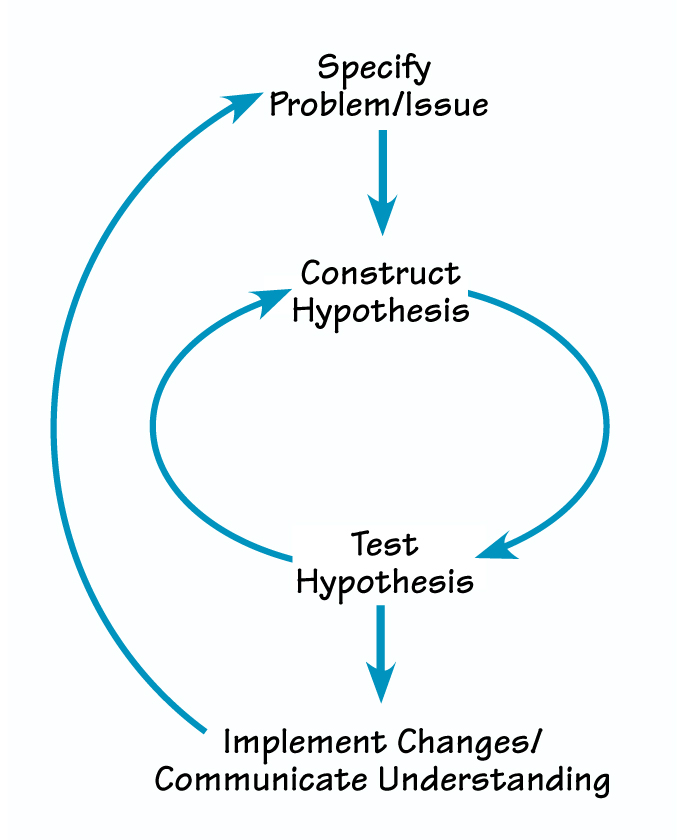
STEPS IN THE SYSTEMS THINKING METHOD

STEPS IN THE SYSTEMSTHINKING METHOD.

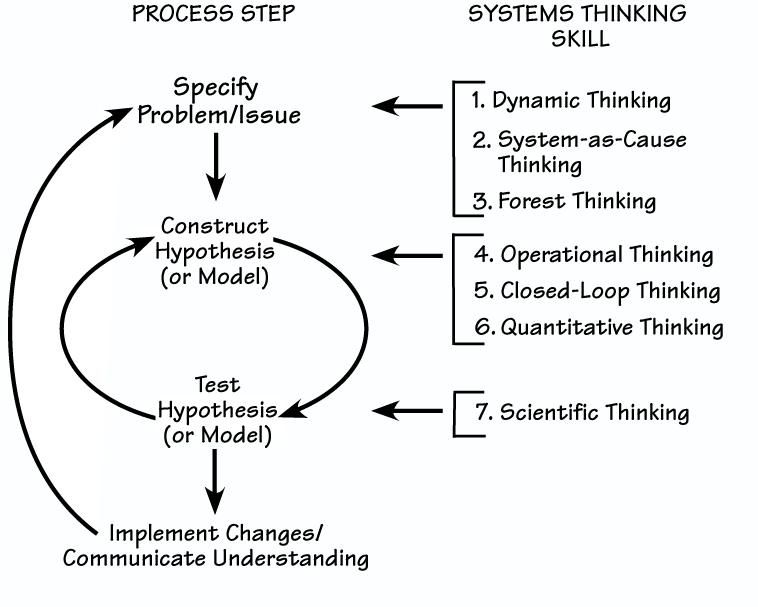
Begin by specifying the problem you want to address. Then construct hypotheses to explain the problem and test them using models. Only when you have a sufficient understanding of the situation should you begin to implement change.

Much like the accomplished basketball player who is unaware of the many separate skills needed to execute a lay-up under game conditions – such as dribbling while running and without looking at the ball, timing and positioning the take-off, extending the ball toward the rim with one hand while avoiding the blocking efforts of defenders – veteran systems thinkers are unaware of the full set of thinking skills that they deploy while executing their craft. By identifying these separate competencies, both new hoop legends and systems thinking wannabes can practice each skill in isolation. This approach can help you master each of the skills before you try to put them all together in an actual game situation.

The Systems Thinking Method

Before exploring these critical thinking skills, it’s important to have a clear picture of the iterative, four-step process used in applying systems thinking (see “Steps in the Systems Thinking Method”). In using this approach, you first specify the problem or issue you wish to explore or resolve. You then begin to construct hypotheses to explain the problem and test them using models whether mental models, pencil and paper models, or computer simulation models. When you are content that you have developed a workable hypothesis, you can then communicate your new found clarity to others and begin to implement change.

When we use the term “models” in this article, we are referring to something that represents a specifically defined set of assumptions about how the world works. We start from a premise that all models are wrong because they are incomplete representations of reality, but that some models are more useful than others (they help us understand reality better than others).  There is a tendency in the business world, however, to view models (especially computer-based models) as “answer generators;” we plug in a bunch of numbers and get out a set of answers. From a systems thinking perspective, however, we view models more as “assumptions and theory testers” we formulate our understanding and then rigorously test it. The bottom line is that all models are only as good as the quality of the thinking that went into creating them. Systems thinking, and its ensemble of seven critical thinking skills, plays an important role in improving the quality of our thinking.

The Seven Critical Thinking Skills

「dynamic Thinking」的圖片搜尋結果

As you undertake a systems thinking process, you will find that the use of certain skills predominates in each step. I believe there are at least seven separate but interdependent thinking skills that seasoned systems thinkers master. The seven unfold in the following sequence when you apply a systems thinking approach: Dynamic Thinking, System-as-Cause Thinking, Forest Thinking, Operational Thinking, Closed-Loop Thinking, Quantitative Thinking, and Scientific Thinking.

The first of these skills, Dynamic Thinking, helps you define the problem you want to tackle.

The next two, System-as-Cause Thinking and Forest Thinking, are invaluable in helping you to determine what aspects of the problem to include, and how detailed to be in representing each.

The fourth through sixth skills, Operational Thinking, Closed-Loop Thinking, and Quantitative Thinking, are vital for representing the hypotheses (or mental models) that you are going to test.

The final skill, Scientific Thinking, is useful in testing your models.

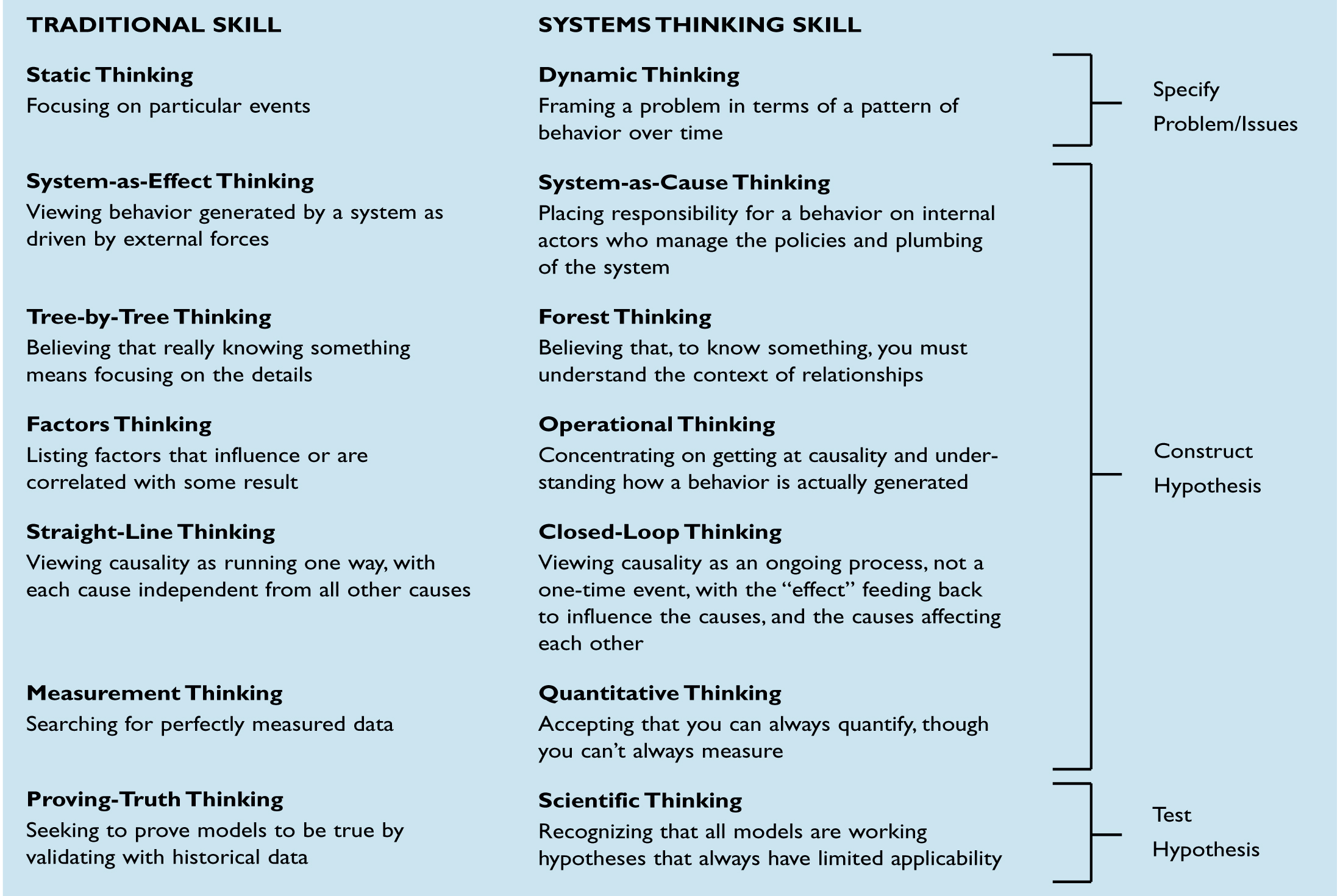
Each of these critical thinking skills serves a different purpose and brings something unique to a systems thinking analysis. Let’s explore these skills, identify how you can develop them, and determine what their “non-systems thinking” counterparts (which dominate in traditional thinking) look like.

Dynamic Thinking: Dynamic Thinking is essential for framing a problem or issue in terms of a pattern of behavior over time. Dynamic Thinking contrasts with Static Thinking, which leads people to focus on particular events. Problems or issues that unfold over time as opposed to one-time occurrences are most suitable for a systems thinking approach.

You can strengthen your Dynamic Thinking skills by practicing constructing graphs of behavior overtime. For example, take the columns of data in your company’s annual report and graph a few of the key variables over time. Divide one key variable by another (such as revenue or profit by number of employees), and then graph the results. Or pick up today’s news-paper and scan the head-lines for any attention-grabbing events. Then think about how you might see those events as merely one interesting point in a variable’s overall trajectory over time. The next time someone suggests that doing this-and-that will fix such-and-such, ask, “Over what time frame? How long will it take? What will happen to key variables over time?”

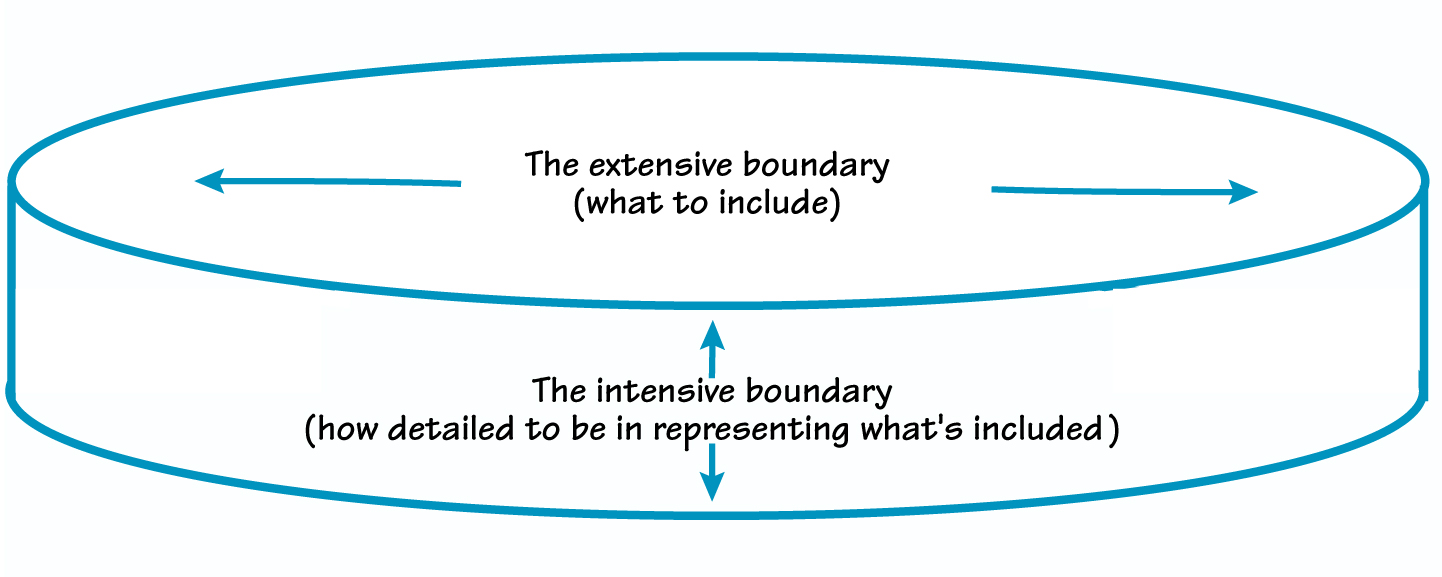
System-as-Cause Thinking: Dynamic Thinking positions your issue as a pattern of behavior over time. The next step is to construct a model to explain how the behavior arises, and then suggest ways to improve that behavior. System-as-Cause Thinking can help you determine the extensive boundary of your model, that is, what to include in your model and what to leave out (see “Extensive and Intensive Model Boundaries”). From a System-as-Cause Thinking approach, you should include only the elements and inter-relationships that are within the control of managers in the system and are capable of generating the behavior you seek to explain.

By contrast, the more common System-as-Effect Thinking views behavior generated by a system as “driven” by external forces. This perspective can lead you to include more variables in your model than are really necessary. System-as-Cause Thinking thus focuses your model more sharply, because it places the responsibility for the behavior on those who manage the policies and plumbing of the system itself.

To develop System-as-Cause Thinking, try turning each “They did it” or “It’s their fault” you encounter into a “How could we have been responsible?” It is always possible to see a situation as caused by “outside forces.” But it is also always possible to ask, “What did we do to make ourselves vulnerable to those forces that we could not control?”

EXTENSIVE AND INTENSIVE MODEL BOUNDARIES

EXTENSIVE AND INTENSIVE MODEL BOUNDARIES

Forest Thinking: In many organizations, people assume that to really know something, they must focus on the details. This assumption is reinforced by day-to-day existence—we experience life as a sequence of detailed events. We can also think of this as Tree-by-Tree Thinking. Models that we create by applying Tree-by-Tree Thinking tend to be large and overly detailed; their intensive boundaries run deep. In using such models, we would want to know whether that particular red truck broke down on Tuesday before noon, as opposed to being interested in how frequently, on average, trucks break down. Forest Thinking–inspired models, by contrast, group the details to give us an “on average” picture of the system. To hone your Forest Thinking skills, practice focusing on similarities rather than differences. For example, although everyone in your organization is unique, each also shares some characteristics with others. While some are highly motivated to perform and others are not, all have the potential to make a contribution. Regardless of the individual, realizing potential within an organization comes from the same generic structure. For example, what is the relationship among factors that tends to govern an individual’s motivation?

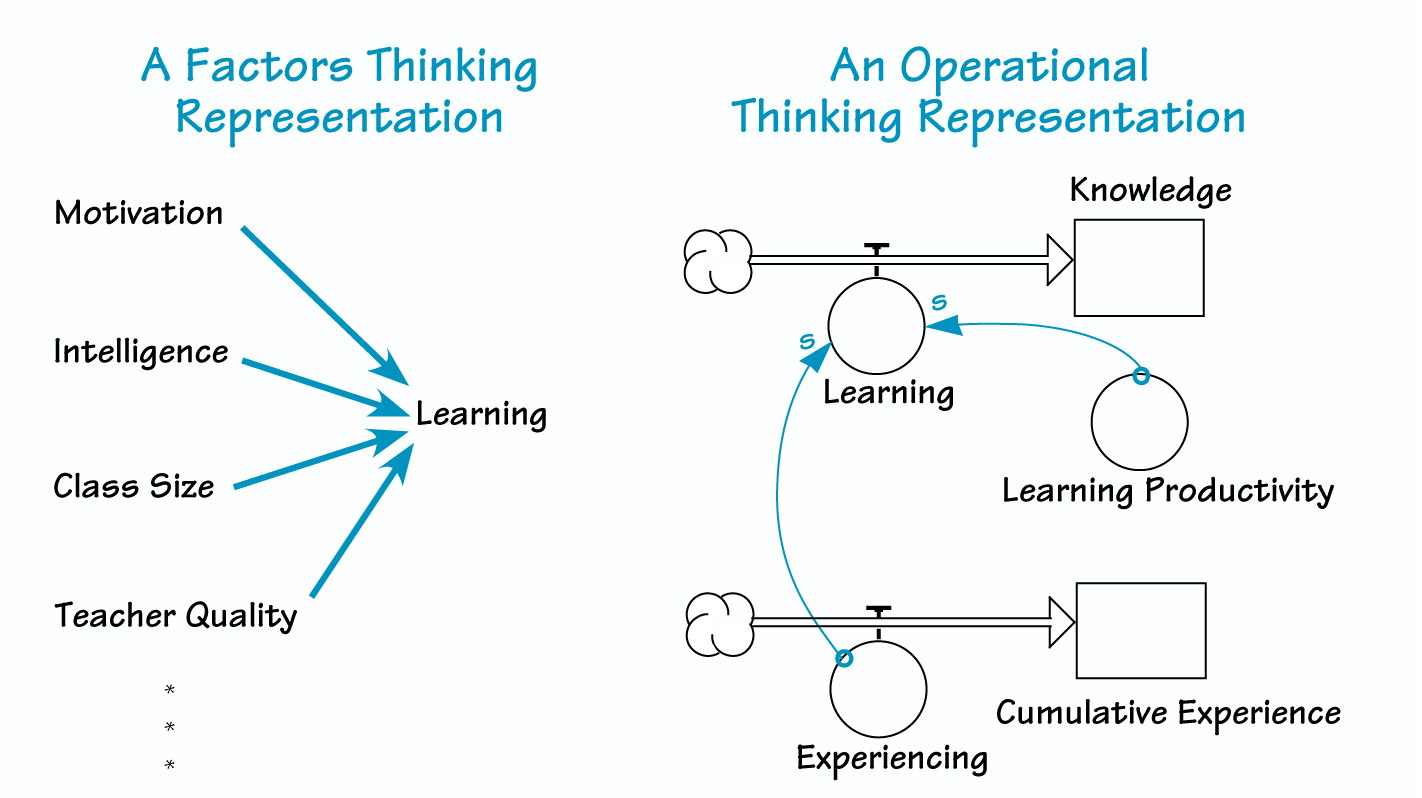
Operational Thinking :Operational Thinking tries to get at causality—how is behavior actually generated? This thinking skill contrasts with Correlational or Factors Thinking. Steven Covey’s The Seven Habits of Highly Effective People, one of the most popular nonfiction books of all time, is a product of Factors Thinking. So are the multitude of lists of “Critical Success Factors” or “Key Drivers of the Business” that decorate the office walls (and mental models) of so many senior executives. We like to think in terms of lists of factors that influence or drive some result.

There are several problems with mental models bearing such list structures, however. For one thing, lists do not explain how each causal factor actually works its magic. They merely imply that each factor “influences,” or is “correlated with,” the corresponding result. But influence or correlation is not the same as causality.

For example, if you use Factors Thinking to analyze what influences learning, you can easily come up with a whole “laundry list” of factors (see “Two Representations of the Learning Process”). But if you use Operational Thinking, you might depict learning as a process that coincides with the building of experience. Operational Thinking captures the nature of the learning process by describing its structure, while Factors Thinking merely enumerates a set of factors that in some way “influence” the process.

To develop your Operational Thinking skills, you need to work your way through various activities that define how a business works examine phenomena such as hiring, producing, learning, motivating, quitting, and setting price. In each case, ask, “What is the nature of the process at work?” as opposed to “What are all of the factors that influence the process?”

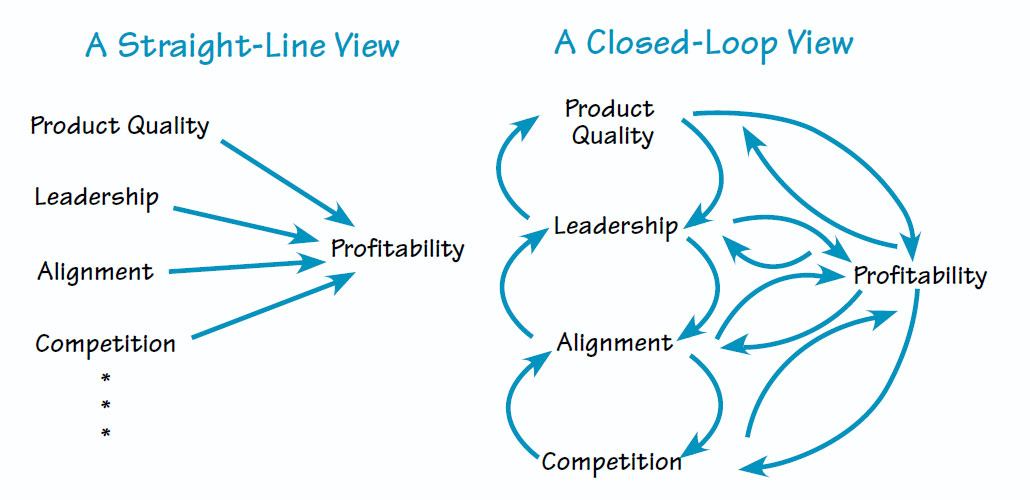
Closed-Loop Thinking :Imagine discussing your company’s profitability situation with some of your coworkers. In most companies, the group would likely list things such as product quality, leadership, or competition as influences on profitability (see “A Straight-Line vs. a Closed-Loop View of Causality”). This tendency to list factors stems from Straight-Line Thinking. The assumptions behind this way of thinking are 1) that causality runs only one way—from “this set of causes” to “that effect,” and 2) that each cause is independent of all other causes. In reality, however, as the closed-loop part of the illustration shows, the “effect” usually feeds back to influence one or more of the “causes,” and the causes themselves affect each other. Closed-Loop Thinking skills therefore lead you to see causality as an ongoing process, rather than a one-time event.
To sharpen your Closed-Loop Thinking skills, take any laundry list that you encounter and think through the ways in which the driven drives and in which the drivers drive each other. Instead of viewing one variable as the most important driver and another one as the second most important, seek to understand how the dominance among the variables might shift over time.

TWO REPRESENTATIONS OF THE LEARNING PROCESS

TWO REPRESENTATIONS OF THE LEARNING PROCESS

Quantitative Thinking: In this phrase, “quantitative” is not synonymous with “measurable.” The two terms are often confused in practice, perhaps because of the presumption in the Western scientific world that “to know, one must measure precisely.” Although Heisenberg’s Uncertainty Principle caused physicists to back off a bit in their quest for numerical exactitude, business folk continue unabated in their search for perfectly measured data. There are many instances of analysis getting bogged down because of an obsession with “getting the numbers right.” Measurement Thinking continues to dominate!

There are a whole lot of things, however, that we will never be able to measure very precisely. These include “squishy,” or “soft,” variables, such as motivation, self-esteem, commitment, and resistance to change. Many so-called “hard” variables are also difficult to measure accurately, given the speed of change and the delays and imperfections in information systems.

A STRAIGHT-LINE VS.A CLOSED-LOOP VIEW OF CAUSALITY

A STRAIGHT-LINE VS.A CLOSED-LOOP VIEW OF CAUSALITS

But let’s return to our “squishy” variables. Would anyone want to argue that an employee’s self-esteem is irrelevant to her performance? Who would propose that commitment is unimportant to a company’s success? Although few of us would subscribe to either argument, things like self-esteem and commitment rarely make it into the spreadsheets and other analytical tools that we use to drive analysis. Why? Because such variables can’t be measured. However, they can be quantified. If zero means a total absence of commitment, 100 means being as committed as possible. Are these numbers arbitrary? Yes. But are they ambiguous? Absolutely not! If you want your model to shed light on how to increase strength of commitment as opposed to predicting what value commitment will take on in the third-quarter of 1997—you can include strength of commitment as a variable with no apologies. You can always quantify, though you can’t always measure.

To improve your Quantitative Thinking skills, take any analysis that your company has crunched through over the last year and ask what key “soft” variables were omitted, such as employee motivation. Then, ruminate about the possible implications of including them systems thinking gives you the power to ascribe full-citizen status to such variables. You’ll give up the ability to achieve perfect measurement. But if you’re honest, you’ll see that you never really had that anyway.

Scientific Thinking: The final systems thinking skill is Scientific Thinking. I call its opposite Proving Truth Thinking. To understand Scientific Thinking, it is important to acknowledge that progress in science is measured by the discarding of falsehoods. The current prevailing wisdom is always regarded as merely an “entertainable hypothesis,” just waiting to be thrown out the window. On the other hand, too many business models are unscientific; yet business leaders revere them as truth and defend them to the death. Analysts make unrelenting efforts to show that their models track history and therefore must be “true.”

Seasoned systems thinkers continually resist the pressure to “validate” their models (that is, prove truth) by tracking history. Instead, they work hard to become aware of the falsehoods in their models and to communicate these to their team or clients. “All models are wrong,”” said W. Edwards Deming. “Some models are useful.” Deming was a smart guy, and clearly a systems thinker.

In using Scientific Thinking, systems thinkers worry less about outfitting their models with exact numbers and instead focus on choosing numbers that are simple, easy to understand, and make sense relative to one another. Systems thinkers also pay lots of attention to robustness they torture-test their models to death! They want to know under what circumstances their model “breaks down.” They also want to know, does it break down in a realistic fashion? What are the limits to my confidence that this model will be useful?

The easiest way to sharpen your Scientific Thinking skills is to start with a computer model that is “in balance” and then shock it. For example, transfer 90% of the sales force into manufacturing. Set price at 10 times competitor price. Triple the customer base in an instant. Then see how the model performs. Not only will you learn a lot about the range of utility of the model, but you also will likely gain insight into the location of that most holy of grails: high-leverage intervention points.

A Divide and Conquer Strategy

As the success of Peter Senge’s The Fifth Discipline: The Art & Practice of the Learning Organization has shown, systems thinking is both sexy and seductive. But applying it effectively is not so easy. One reason for this difficulty is that the thinking skills needed to do so are many in number and stand in stark contrast to the skill set that most of us currently use when we grapple with business issues (see “Traditional Business Thinking vs. Systems Thinking Skills”).

By separating and examining the seven skills required to apply systems thinking effectively, you can practice them one at a time. If you master the individual skills first, you stand a much better chance of being able to put them together in a game situation. So, practice . . . then take it to the hoop!

“Barry Richmond is the managing director and founder of High Performance Systems, Inc. He has a PhD in system dynamics from the MIT Sloan School of Management, an MS from Case Western Reserve, and an MBA from Columbia University”

TRADITIONAL BUSINESS THINKING VS. SYSTEMS THINKING SKILLS

TRADITIONAL BUSINESS THINKING VS. SYSTEMS THINKING SKILLS

Elon Musks’ “3-Step” First Principles Thinking: How to Think and Solve Difficult Problems Like a Genius

Mayo Oshin

Musk (Flickr CC // Bill David Brooks)

By the age of 46 years old, Elon Musk has innovated and built three revolutionary multibillion dollar companies in completely different fields — Paypal (Financial Services), Tesla Motors (Automotive) and SpaceX (Aerospace).

This list doesn’t even include Solar City (Energy), which he helped build and acquired for $2.6 Billion recently.

At first glance, it’s easy to link his rapid success, ability to solve unsolvable problems and genius level creativity to his incredible work ethic.

Musk himself stated that he worked approximately 100 hours a week for over 15 years and recently scaled down to 85 hours. Rumour also has it that he doesn’t even take lunch breaks, multitasking between eating, meetings and responding to emails all at the same time.

No doubt work ethic plays an important role in unlocking your inner creative genius and becoming the best at what you do — but there’s more to this — there are extremely hard-working people who still make little progress in life and die before sharing their best work with the world.

What then is this missing link for innovative creativity and accelerated success?

Just like Musk, some of the most brilliant minds of all-time — Aristotle, Euclid, Thomas Edison, Feynman and Nikola Tesla — use this missing link for accelerated learning, solving difficult problems and creating great work in their lifetime.

This missing link has little to do with how hard they work. It has everything to do with how they think.

Let’s talk about how you can quickly use this genius problem solving method.

First Principles Thinking

During a one on one interview with TED Curator, Chris Anderson, Musk reveals this missing link which he attributes to his genius level creativity and success. It’s called reasoning from “First Principles.” [1]

Musk: Well, I do think there’s a good framework for thinking. It is physics. You know, the sort of first principles reasoning. Generally I think there are — what I mean by that is, boil things down to their fundamental truths and reason up from there, as opposed to reasoning by analogy.

Through most of our life, we get through life by reasoning by analogy, which essentially means copying what other people do with slight variations.

In layman’s terms, first principles thinking is basically the practice of actively questioning every assumption you think you ‘know’ about a given problem or scenario — and then creating new knowledge and solutions from scratch. Almost like a newborn baby.

On the flip side, reasoning by analogy is building knowledge and solving problems based on prior assumptions, beliefs and widely held ‘best practices’ approved by majority of people.

People who reason by analogy tend to make bad decisions, even if they’re smart.


FOOTNOTES

  1. In this interview, Musk talks about this 100 hour work week. This is his interview on TED about first principles thinking.
  2. Musk gave this answer to a question from a reader asking him how he learns so fast. (source)
  3. Musk’s interview with Kevin Rose on first principles thinking and battery analogy.
  4. This is not always easy. In fact, sometimes it can be a tough mental workout to use first principles thinking simply because it’s much easier to default back to what you already ‘know.’ Because of our prior assumptions and limiting beliefs, we have a tendency to only think of a very limited range of creative uses or solutions to any given problem. This is more formally known as “functional fixedness”.Dr.Tony McCaffery, Cognitive Psychologist and Innovation expert, has developed a simple method that can help us overcome this tendency and uncover creative solutions. You can read about his “general parts technique” here.
  5. Thanks to peter at renaissance man journal for some inspiring insights on first principles thinking.

Techniques for Establishing First Principles

Techniques for Establishing First Principles

There are many ways to establish first principles. Let’s take a look at a few of them.

Socratic Questioning

Socratic questioning can be used to establish first principles through stringent analysis. This a disciplined questioning process, used to establish truths, reveal underlying assumptions, and separate knowledge from ignorance. The key distinction between Socratic questioning and normal discussions is that the former seeks to draw out first principles in a systematic manner. Socratic questioning generally follows this process:

  1. Clarifying your thinking and explaining the origins of your ideas (Why do I think this? What exactly do I think?)
  2. Challenging assumptions (How do I know this is true? What if I thought the opposite?)
  3. Looking for evidence (How can I back this up? What are the sources?)
  4. Considering alternative perspectives (What might others think? How do I know I am correct?)
  5. Examining consequences and implications (What if I am wrong? What are the consequences if I am?)
  6. Questioning the original questions (Why did I think that? Was I correct? What conclusions can I draw from the reasoning process?)

This process stops you from relying on your gut and limits strong emotional responses. This process helps you build something that lasts.

“Because I Said So” or “The Five Whys”

Children instinctively think in first principles. Just like us, they want to understand what’s happening in the world. To do so, they intuitively break through the fog with a game some parents have come to hate.

“Why?”

“Why?”

“Why?”

Here’s an example that has played out numerous times at my house:

“It’s time to brush our teeth and get ready for bed.”

“Why?”

“Because we need to take care of our bodies, and that means we need sleep.”

“Why do we need sleep?”

“Because we’d die if we never slept.”

“Why would that make us die?”

“I don’t know; let’s go look it up.”

Kids are just trying to understand why adults are saying something or why they want them to do something.

The first time your kid plays this game, it’s cute, but for most teachers and parents, it eventually becomes annoying. Then the answer becomes what my mom used to tell me: “Because I said so!” (Love you, Mom.)

Of course, I’m not always that patient with the kids. For example, I get testy when we’re late for school, or we’ve been travelling for 12 hours, or I’m trying to fit too much into the time we have. Still, I try never to say “Because I said so.”

People hate the “because I said so” response for two reasons, both of which play out in the corporate world as well. The first reason we hate the game is that we feel like it slows us down. We know what we want to accomplish, and that response creates unnecessary drag. The second reason we hate this game is that after one or two questions, we are often lost. We actually don’t know why. Confronted with our own ignorance, we resort to self-defense.

I remember being in meetings and asking people why we were doing something this way or why they thought something was true. At first, there was a mild tolerance for this approach. After three “whys,” though, you often find yourself on the other end of some version of “we can take this offline.”

Difference between Analogy and The F.P

Another way to think about this distinction comes from another friend, Tim Urban. He says[3] it’s like the difference between the cook and the chef. While these terms are often used interchangeably, there is an important nuance. The chef is a trailblazer, the person who invents recipes. He knows the raw ingredients and how to combine them. The cook, who reasons by analogy, uses a recipe. He creates something, perhaps with slight variations, that’s already been created.

The difference between reasoning by first principles and reasoning by analogy is like the difference between being a chef and being a cook. If the cook lost the recipe, he’d be screwed. The chef, on the other hand, understands the flavor profiles and combinations at such a fundamental level that he doesn’t even use a recipe. He has real knowledge as opposed to know-how.

Examples of First Principles in Action

So we can better understand how first-principles reasoning works, let’s look at four examples.

Elon Musk and SpaceX

Perhaps no one embodies first-principles thinking more than Elon Musk. He is one of the most audacious entrepreneurs the world has ever seen. My kids (grades 3 and 2) refer to him as a real-life Tony Stark, thereby conveniently providing a good time for me to remind them that by fourth grade, Musk was reading the Encyclopedia Britannica and not Pokemon.

What’s most interesting about Musk is not what he thinks but how he thinks:

I think people’s thinking process is too bound by convention or analogy to prior experiences. It’s rare that people try to think of something on a first principles basis. They’ll say, “We’ll do that because it’s always been done that way.” Or they’ll not do it because “Well, nobody’s ever done that, so it must not be good. But that’s just a ridiculous way to think. You have to build up the reasoning from the ground up—“from the first principles” is the phrase that’s used in physics. You look at the fundamentals and construct your reasoning from that, and then you see if you have a conclusion that works or doesn’t work, and it may or may not be different from what people have done in the past.[4]

His approach to understanding reality is to start with what is true — not with his intuition. The problem is that we don’t know as much as we think we do, so our intuition isn’t very good. We trick ourselves into thinking we know what’s possible and what’s not. The way Musk thinks is much different.

Musk starts out with something he wants to achieve, like building a rocket. Then he starts with the first principles of the problem. Running through how Musk would think, Larry Page said in an

interview, “What are the physics of it? How much time will it take? How much will it cost? How much cheaper can I make it? There’s this level of engineering and physics that you need to make judgments about what’s possible and interesting. Elon is unusual in that he knows that, and he also knows business and organization and leadership and governmental issues.”[5]

Rockets are absurdly expensive, which is a problem because Musk wants to send people to Mars. And to send people to Mars, you need cheaper rockets. So he asked himself, “What is a rocket made of? Aerospace-grade aluminum alloys, plus some titanium, copper, and carbon fiber. And … what is the value of those materials on the commodity market? It turned out that the materials cost of a rocket was around two percent of the typical price.”[6]

Why, then, is it so expensive to get a rocket into space? Musk, a notorious self-learner with degrees in both economics and physics, literally taught himself rocket science. He figured that the only reason getting a rocket into space is so expensive is that people are stuck in a mindset that doesn’t hold up to first principles. With that, Musk decided to create SpaceX and see if he could build rockets himself from the ground up.

In an interview with Kevin Rose, Musk summarized his approach:

I think it’s important to reason from first principles rather than by analogy. So the normal way we conduct our lives is, we reason by analogy. We are doing this because it’s like something else that was done, or it is like what other people are doing… with slight iterations on a theme. And it’s … mentally easier to reason by analogy rather than from first principles. First principles is kind of a physics way of looking at the world, and what that really means is, you … boil things down to the most fundamental truths and say, “okay, what are we sure is true?” … and then reason up from there. That takes a lot more mental energy.[7]

Musk then gave an example of how Space X uses first principles to innovate at low prices:

Somebody could say — and in fact people do — that battery packs are really expensive and that’s just the way they will always be because that’s the way they have been in the past. … Well, no, that’s pretty dumb… Because if you applied that reasoning to anything new, then you wouldn’t be able to ever get to that new thing…. you can’t say, … “oh, nobody wants a car because horses are great, and we’re used to them and they can eat grass and there’s lots of grass all over the place and … there’s no gasoline that people can buy….”

He then gives a fascinating example about battery packs:

… they would say, “historically, it costs $600 per kilowatt-hour. And so it’s not going to be much better than that in the future. … So the first principles would be, … what are the material constituents of the batteries? What is the spot market value of the material constituents? … It’s got cobalt, nickel, aluminum, carbon, and some polymers for separation, and a steel can. So break that down on a material basis; if we bought that on a London Metal Exchange, what would each of these things cost? Oh, jeez, it’s … $80 per kilowatt-hour. So, clearly, you just need to think of clever ways to take those materials and combine them into the shape of a battery cell, and you can have batteries that are much, much cheaper than anyone realizes.

BuzzFeed

After studying the psychology of virality, Jonah Peretti founded BuzzFeed in 2006. The site quickly grew to be one of the most popular on the internet, with hundreds of employees and substantial revenue.

Peretti figured out early on the first principle of a successful website: wide distribution. Rather than publishing articles people should read, BuzzFeed focuses on publishing those that people want to read. This means aiming to garner maximum social shares to put distribution in the hands of readers.

Peretti recognized the first principles of online popularity and used them to take a new approach to journalism. He also ignored SEO, saying, “Instead of making content robots like, it was more satisfying to make content humans want to share.”[8] Unfortunately for us, we share a lot of cat videos.

A common aphorism in the field of viral marketing is, “content might be king, but distribution is queen, and she wears the pants” (or “and she has the dragons”; pick your metaphor). BuzzFeed’s distribution-based approach is based on obsessive measurement, using A/B testing and analytics.

Jon Steinberg, president of BuzzFeed, explains the first principles of virality:

Keep it short. Ensure [that] the story has a human aspect. Give people the chance to engage. And let them react. People mustn’t feel awkward sharing it. It must feel authentic. Images and lists work. The headline must be persuasive and direct.

Derek Sivers and CD Baby

When Sivers founded his company CD Baby, he reduced the concept down to first principles. Sivers asked, What does a successful business need? His answer was happy customers.

Instead of focusing on garnering investors or having large offices, fancy systems, or huge numbers of staff, Sivers focused on making each of his customers happy. An example of this is his famous order confirmation email, part of which reads:

Your CD has been gently taken from our CD Baby shelves with sterilized contamination-free gloves and placed onto a satin pillow. A team of 50 employees inspected your CD and polished it to make sure it was in the best possible condition before mailing. Our packing specialist from Japan lit a candle and a hush fell over the crowd as he put your CD into the finest gold-lined box money can buy.

By ignoring unnecessary details that cause many businesses to expend large amounts of money and time, Sivers was able to rapidly grow the company to $4 million in monthly revenue. In Anything You Want, Sivers wrote:

Having no funding was a huge advantage for me.
A year after I started CD Baby, the dot-com boom happened. Anyone with a little hot air and a vague plan was given millions of dollars by investors. It was ridiculous. …
Even years later, the desks were just planks of wood on cinder blocks from the hardware store. I made the office computers myself from parts. My well-funded friends would spend $100,000 to buy something I made myself for $1,000. They did it saying, “We need the very best,” but it didn’t improve anything for their customers. …
It’s counterintuitive, but the way to grow your business is to focus entirely on your existing customers. Just thrill them, and they’ll tell everyone.

To survive as a business, you need to treat your customers well. And yet so few of us master this principle.


Employing First Principles in Your Daily Life

Most of us have no problem thinking about what we want to achieve in life, at least when we’re young. We’re full of big dreams, big ideas, and boundless energy. The problem is that we let others tell us what’s possible, not only when it comes to our dreams but also when it comes to how we go after them. And when we let other people tell us what’s possible or what the best way to do something is, we outsource our thinking to someone else.

The real power of first-principles thinking is moving away from incremental improvement and into possibility. Letting others think for us means that we’re using their analogies, their conventions, and their possibilities. It means we’ve inherited a world that conforms to what they think. This is incremental thinking.

When we take what already exists and improve on it, we are in the shadow of others. It’s only when we step back, ask ourselves what’s possible, and cut through the flawed analogies that we see what is possible. Analogies are beneficial; they make complex problems easier to communicate and increase understanding. Using them, however, is not without a cost. They limit our beliefs about what’s possible and allow people to argue without ever exposing our (faulty) thinking. Analogies move us to see the problem in the same way that someone else sees the problem.

The gulf between what people currently see because their thinking is framed by someone else and what is physically possible is filled by the people who use first principles to think through problems.

First-principles thinking clears the clutter of what we’ve told ourselves and allows us to rebuild from the ground up. Sure, it’s a lot of work, but that’s why so few people are willing to do it. It’s also why the rewards for filling the chasm between possible and incremental improvement tend to be non-linear.

Let’s take a look at a few of the limiting beliefs that we tell ourselves.

“I don’t have a good memory.” [10]
People have far better memories than they think they do. Saying you don’t have a good memory is just a convenient excuse to let you forget. Taking a first-principles approach means asking how much information we can physically store in our minds. The answer is “a lot more than you think.” Now that we know it’s possible to put more into our brains, we can reframe the problem into finding the most optimal way to store information in our brains.

“There is too much information out there.”
A lot of professional investors read Farnam Street. When I meet these people and ask how they consume information, they usually fall into one of two categories. The differences between the two apply to all of us. The first type of investor says there is too much information to consume. They spend their days reading every press release, article, and blogger commenting on a position they hold. They wonder what they are missing. The second type of investor realizes that reading everything is unsustainable and stressful and makes them prone to overvaluing information they’ve spent a great amount of time consuming. These investors, instead, seek to understand the variables that will affect their investments. While there might be hundreds, there are usually three to five variables that will really move the needle. The investors don’t have to read everything; they just pay attention to these variables.

“All the good ideas are taken.”
A common way that people limit what’s possible is to tell themselves that all the good ideas are taken. Yet, people have been saying this for hundreds of years — literally — and companies keep starting and competing with different ideas, variations, and strategies.

“We need to move first.”
I’ve heard this in boardrooms for years. The answer isn’t as black and white as this statement. The iPhone wasn’t first, it was better. Microsoft wasn’t the first to sell operating systems; it just had a better business model. There is a lot of evidence showing that first movers in business are more likely to fail than latecomers. Yet this myth about the need to move first continues to exist.

Sometimes the early bird gets the worm and sometimes the first mouse gets killed. You have to break each situation down into its component parts and see what’s possible. That is the work of first-principles thinking.

“I can’t do that; it’s never been done before.”
People like Elon Musk are constantly doing things that have never been done before. This type of thinking is analogous to looking back at history and building, say, floodwalls, based on the worst flood that has happened before. A better bet is to look at what could happen and plan for that.

“As to methods, there may be a million and then some, but principles are few. The man who grasps principles can successfully select his own methods. The man who tries methods, ignoring principles, is sure to have trouble.”

— Harrington Emerson

Conclusion

The thoughts of others imprison us if we’re not thinking for ourselves.

Reasoning from first principles allows us to step outside of history and conventional wisdom and see what is possible. When you really understand the principles at work, you can decide if the existing methods make sense. Often they don’t.

Reasoning by first principles is useful when you are (1) doing something for the first time, (2) dealing with complexity, and (3) trying to understand a situation that you’re having problems with. In all of these areas, your thinking gets better when you stop making assumptions and you stop letting others frame the problem for you.

Analogies can’t replace understanding. While it’s easier on your brain to reason by analogy, you’re more likely to come up with better answers when you reason by first principles. This is what makes it one of the best sources of creative thinking. Thinking in first principles allows you to adapt to a changing environment, deal with reality, and seize opportunities that others can’t see.

Many people mistakenly believe that creativity is something that only some of us are born with, and either we have it or we don’t. Fortunately, there seems to be ample evidence that this isn’t true.[11] We’re all born rather creative, but during our formative years, it can be beaten out of us by busy parents and teachers. As adults, we rely on convention and what we’re told because that’s easier than breaking things down into first principles and thinking for ourselves. Thinking through first principles is a way of taking off the blinders. Most things suddenly seem more possible.

“I think most people can learn a lot more than they think they can,” says Musk. “They sell themselves short without trying. One bit of advice: it is important to view knowledge as sort of a semantic tree — make sure you understand the fundamental principles, i.e., the trunk and big branches, before you get into the leaves/details or there is nothing for them to hang on to.”

引發驚人的爆炸力! Elon Musk 知識軍火庫中最強殺傷力的武器 : 「第一性原理」( First Principle )

「我會運用「第一性原理」思維而不是「類比」思維去思考問題。在日常生活中,人總是傾向於比較 — — 別人已經做過了或者正在做這件事情,我們也就去做。這樣的結果只能產生細小的叠代發展。「第一性原理」的思考方式是用物理學的角度看待世界的方法,也就是說一層層剝開事物的表象,看到裏面的本質,然後再從本質一層層往上走。」

— SpaceX、Tesla 電動汽車 及 PayPal 創辦人 Elon Musk

什麼是 「第一性原理」( First Principle )?

所謂的「第一性原理」是一個量子力學中的一個術語,意思是從頭開始計算,只採用最基本的事實,然後根據事實推論,創造出新價值。在 Elon Musk 開發 Tesla 特斯拉電動車案例中,很多專家覺得電動車是不可能流行起來,因為電池成本在歷史上一直也降不下來。600美元 / 千瓦是市場的公價,電池從一直也是那麼貴,它的改進和降價總是很慢,所以它未來短時間內也不大可能大幅度降低價格。

但 Elon Musk 卻不認同,在他公司新電池的開發階段中,他率先屏棄現時市場所有生產電池組的已有技術,把電池組的構成物質全部分解,還原成最基礎的材料:碳、鎳、鋁及其他用於分離的聚合物,這種還原使他了解到重新構成了製造電池的「基本事實」( Fact )是什麼 。

無可否認,上述的金屬成本如果在市場需求沒有大幅度改變下,是絕對降不下去的,可是他卻發現了當中剩下來的成本還包含了很大部份是屬於「人類協作過程」而生的成本,而他相信凡是人類協進的事情,就必定存在優化空間。

透過這些「基本事實」,Elon Musk 和團隊再把原材料每個部分再細緻分析及實驗,並把每項工作流程再優化重組,比如,在美國生產可能稅費比較高,那就不要在美國生產了;某種原有技術的模塊設計上出了問題,那就改變設計,最後他和團隊把各部份優化原件,加上全面改良的生產方法,整合成現時以能大幅度降低電池的生產成本為前提的電動汽車。

而把「第一性原理」的思想放在 Elon Musk 的 SpaceX 計劃,他也同樣挑戰過去太空運輸技輸產業中「成本就是那麼貴」的專家偏見,他先還原製造火箭「基本事實」,發現了一架火箭的原料成本原來只佔火箭的總成本的2%,而餘下的成本其實是其他製造過程的成本,而有了這層認知,他便朝著優化另外98% 的成本方向,把現時製造火箭的成本,降低了到現時的10% 。

這就是「第一性原理」( First Principle ) 的爆炸力。

可是為什麼我們明明和 Elon Musk 身處在同一個世界,卻看不到 Elon Musk 看到的「第一性原理」( First Principle )?為什麼?難道真的只是因為他比較有錢,接觸到較多高級知識份子嗎?總結原因,我認為有三大理由:

一、我們看不到,因為我們缺乏「硬學科」訓練

「第一性原理」( First Principle ) 其實是事物底層規律的總結,就以泥石流作為例子,當你知道「從山頂上滾下的石頭會愈來愈快」這個基本事實後,如果當你不幸遇上泥石流時,你會選擇儘可能往山的兩側跑,而不是和順著山谷和泥石比拼鬥快,這個知識對你來說,可算是「野外求生」的知識,然而如果你能把這個知識發掘到底層,它其實就是為牛頓第二定律 F=ma,有了這個底層知識,你不單能避開泥石流,更有可能想出造火箭方法。

而你能把這個大家也看得見的眼前「基本事實」,或「野外求生」知識,向底層發掘為大家也無法輕易以肉見看見的牛頓第二定律 F=ma,需要的就是「硬學科」,例如數學、物理及化學。這些「硬學科」也許我們在求學時期早已學過,但在現在日常生活中,或許只餘下發薪水或買菜時,常用的加減乘除外,才有用武之地。

那為什麼我們從不會思考過如何融會貫通地使用呢?因為我們不明白這些「硬學科」價值在哪裏。

相比起心理學、經濟學和社會學等人文學科需經常配搭前置假設才能應用,「硬學科」是完全建立在基礎假設及邏輯思維分析之上,例如數學就是一個完全不依托真實存在的世界,透過假定範圍,幾乎所有的推論都是正確,因此它的知識可以算是更可靠,更貼近「第一性原理」( First Principle ) 的本質。

二、我們看不到,因我們「自以為知道」

1-iRQxhL6wWNVL9Tybmlo7ZA

在一般學習書藉經常提到 : 個人認知的「知道」與事實上的「知道」的四象限中,我嘗試提再把它演繹為四個不同的層次 :

不知道自己不知道」Level 1 :以為自己什麼都知道,自以為是的認知狀態

「知道自己不知道」Level 2 :有敬畏之心,開始空杯心態,準備好投入學習

「知道自己知道」Level 3 :抓住了事情的規律,提升了自己的認知

「極致的意會」Level 4:對事情的掌握,已經變成一種渾然天成的意會,在別人輾轉思量之際,你已立即能下準確的決定

認知」幾乎是人和人之間唯一的本質差別,技能的差別是可量化,但認知的差別卻是本質性的,不可量化。人和人比拼的除了是實踐力外,更重要是洞察力,

你的求知慾通常是由「你知道了自己不知道」(Level 2 )開始產生; 人選擇不去求知,主要是因為大部份人一直也停留在「不知道自己不知道」(Level 1 )。

「不知道自己不知道」(Level 1 )的狀態是因為自己連那個「不知道」是什麼都沒有搞清楚,這就好比西醫只知「發炎」,而不知何謂「上火」。

對中醫來說,西醫所謂的「發炎」( Inflammation ),其實是指「上火」,而火是有「實火」與「虛火」之分,而在虛實之中,治療方法也是可以完全截然相反。

而西醫卻因為從不知「上火」一字 ( 或可以說就算就知道,也不重視「上火」在西方醫學知識系統的融合 ),只相信「發炎」便能解釋一切現象,因此亦錯過了在辨症時,以虛實之火去下更準確的藥方的機會,也錯過了自己發掘應對炎症不同程度症狀的新啟發,這就是「不知道自己不知道」(Level 1 )的狀態所引發的問題。

三、我們看不到,因為我們「急功近利」的學習態度

學習是需要「基本功」的累積,凡事追根究底,深入學習,是要經歷流汗、未知、腦汁和時間付出。在華人以「考試結果及職業導向為最終學習目的」的情況下,我們早已失去了對學習的深索熱情和樂趣。

當你身邊人也在職場的高速公路上怒奔,大家終日也在看「三分鐘學會Google 的創新法則」,「三十分鐘不敗精讀法」,「三天快速增加你的財富收入」,並和你吹噓著上述的方法是如何啟發及有效,在創業場或職場上同樣具有競爭心的你怎能不焦急?在這裏我和你談學習需要時間練「基本功」,你也許會想 : 「別人都已進步都那麼快,再談基本功我就已做大輸家了!」

可是請停一停,讓我們能否用科學化的方法,再重新思考一下:

1-6kv4nvCkox3coCoJXpSG0w

在正常人的能力成長曲綫中,其曲線的前期一般會隨著學會了具體方法和技術後快速增加,我們解決問題的時間會愈來愈短,對一些開始時還是有難度的事情,到達中期頂峰階段,經過練習後就會變得易如反掌,可是這個成長曲線到達後期就會失去向上升的動力,為什麼?

因為我們大多數人在日常認識問題時,一般只會依靠直覺、個人經驗、簡單的線性思維、因果關係、意識形態和價值觀偏好,而這些思維卻會引發 :

(1)我們無法發現事情之間深層次的關聯,我們眼前的認知都是一個分散的點,是一種孤立且斷裂式的認知,例如你無法明白到底 SpaceX 和 Tesla 電動汽車到底有什麼關係?

(2)我們面對超出自己日常工作的問題時,不知從何下手,更無法準確把握關鍵環節並合埋地預測事情的發展趨勢,例如你無法理解如何由電池組的構成基本原素,預測到解決澳洲電力危機的解決方向?

我們經常都聽到身邊那些在職場闖蕩了幾年的人會埋怨自己在公司已學不到任何新事物,感覺成長已到達天花板,真正原因不是你成長得太快,而是因為你的天花板太矮了。這個天花板,就是由你急功近利的學習方法所造成,因為你只看到天花板一個個孤立的點,而看不到天花板外原來還有樓宇的鋼筋水泥結構,城市空間的規劃原則,城市的發展的建築歷史。

相反如果我們能反其道,以慢打快,採用「第一性原理」( First Principle ) 的學習原則,我們的成長曲線就會出現這個模樣 :

1-hzcgUJuL83Q1BVvAzzcyLw

我們在學習的前期,雖然會因自己需不斷訓練和掌握基本原則,而令學習速度變慢,但當我們掌握了整個學科的理念和方法後,學習的能力就會大幅提升。

你可以透過「第一性原理」( First Principle ) ,從底層的規律,以跨領域的方式,不停地活潑游走並累積,而隨著你的知識愈多,你的成長曲線會增長得愈來愈快,而當你能整合的知識愈多,你的知識就開始產生了爆炸性的威力 (股神巴菲特最親密的戰友 Charlie Munger 稱之為「Lollapalooza Effect」),透過這種學習和成長,你會更容易獲得對未來更準確的「預測」,從而獲得先機,成為產業中的新先知。

1-JWbsfIQ6aJW2xlmrFq9IXg

鑽研知識的路,從不擁擠

我曾經聽過長輩感嘆 : 「今天是一個資訊和知識爆炸的社會,比起以往互聯網年代前的世界,當年的世界單純和清靜好多。」我認為這個觀念是謬誤,人類文明的發展,本來就是包含著混亂和喧鬧,以往的世界你覺得清靜,是因為訊息傳遞缺乏效率,而訊息內容的力量在傳遞的過程中,也會像熱力傳遞過程中會逐步遞減,所以接受者才不會有現在如直播般的「衝擊」。

同時,我們必須在一片「資訊和知識已爆炸」喧鬧聲,重新分清在這些爆炸中,到底什麼是「資料」、「資訊」和「知識」(這個分類將會在下一篇文章詳細解釋 ),現今的社會爆炸的是「資訊」,更正確來說是「垃圾資訊」,而非知識。知識的製造門檻是極高,並非你說爆就爆,因此鑽研知識的路,是又闊又人煙稀少,你以為人多的部份其實也不過追求快速「學習具體技巧」的方法論人群,它們和我們今天所分享的「第一性原理」( First Principle ) 或底層定律,是完全在處於不同的程度 。

總結今天的分享內容,我們理解了 :

1. 「第一性原理」( First Principle ) 的定義

2. 我們看不到的「第一性原理」( First Principle ) 的原因 : 缺乏「硬學科」訓練、「自以為知道」「急功近利」的學習態度

3. 我們學習「第一性原理」( First Principle ) 的好處 : 獲得長遠累進的成長曲線; 得到對未來的洞見及獲得機遇

由今天起,讓我們一起刻意練習( Deliberate Practice ) :

  1. 最近幾年,有什麼知識是你當初認為是不重要,但後來你才後悔自己沒有早點知道?
  2. 反思自己在上述過程中,有什麼關鍵的事件、人物或原因令你醒覺上述的知識真的很重要?
  3. 嘗試運用「第一性原理」( First Principle ) 的思考方式,發掘出你在學習認知中,那些經常見到但自己卻一直沒有觀察到事情,並找出改良方法,例如 :

為什麼我對數字總是很不敏感?

原來過去我總會以「人類是有血有肉,不能被量化」和「人的靈感直覺比機械式操作更重要」這類借口,輕忽了逃避學習數理 ;

那為什麼我會輕忽數理的重要性?

因為我是人文學科的人,所以每次面對數理相關的問題都會總是很沒有安全感,覺得自己比理科生低人一等……

也許你會有興趣

附註:

Elon Musk Photo Credit http://media2.govtech.com/

Mental models ( DefMarco)

These are some mental models I find useful. They’re rooted in decades of experience of thousands of experts – a modern equivalent of folk wisdom. Mental models are useful to quickly and correctly reason about seemingly intractable problems. They require quite a bit of intuition to properly internalize, but once you’ve internalized them they’re relatively easy to apply. They’re also easy to forget in the moment – use this post as a checklist when thinking about complex problems.

This is a living document. Instead of creating an exhaustive list on day one, I will add models as they arise (and as I discover new ones).

Productivity

  • The small-improvements method – the observation that psychologically frequently making small incremental improvements is a better approach than attempting to fix big looming problems once.
  • The just-get-started method – Joel Spolsky’s observation that just starting to work on a small, concrete, finishable problem puts your consciousness in a productive state.
    Corollary: Just do something concrete. Anything. Do your laundry, or dust the counters, or add a single unit test. Just do something.
  • The top-five-problems method – Richard Hamming’s algorithm for doing important work. Periodically ask yourself: “what are the top five most important problems in my field (and life), and why am I not working on them?”
    Corollary: What are the top five most important problems in your field (and life), and why aren’t you working on them?
  • The LRU prioritization method – since you can only work on one problem at a time, it’s usually sufficient to pick the most important problem, work on that, and ignore everything else. This method also works with organizing most things (from email to physical possessions).
  • The teaching method – Richard Feynman’s observation that teaching the basics is an excellent method for generating profound new ideas, and for putting consciousness in a productive state.
    Corollary: If you’re stuck, put yourself in a position where you have to teach someone the basics.
  • Planning fallacy – the observation that humans are overly optimistic when predicting success of their undertakings. Empirically, the average case turns out to be worse than the worst case human estimate.
    Corollary: Be really pessimistic when estimating. Assume the average case will be slightly worse than the hypothetical worst case.
    Corollary: When estimating time, upgrade the units and double the estimate (e.g. convert “one week” to “two months”).
  • Forcing function – an external, usually social, constraint that increases the probability of accomplishing a set of tasks.
    Example: Pair programming.

Hypothesis evaluation

  • Efficient market hypothesis – the state of any given issue in the world is roughly as close to optimal as is currently possible.
    Corollary: It’s unlikely that the status quo can be easily improved without significant resources.
    Example: Cucumber juice probably doesn’t cure cancer.
    Example: The iPhone app you wrote in a weekend probably doesn’t double the phone’s battery life.
  • Statistical mechanics – probabalistic systems that follow certain laws in the long run can have perturbations that diverge from these laws in the short run.
    Corollary: Occasionally the status quo can be easily improved without significant resources (but it is unlikely that you found such an occassion).
    Idiom: In the short run the market is a voting machine, but in the long run it is a weighing machine.
    Idiom: If an economist saw a $100 bill on a sidewalk they wouldn’t pick it up (because if it were real, it would have been picked up already).
  • Base rates – you can approximate the likelihood of a specific event occurring by examining the wider probability distribution of similar events.
    Example: You’re evaluating the probability of success of a given startup. Ask yourself, if you saw ten similar startups a year, how many of them are likely to succeed?
    Example: You caught an employee stealing, but they claim they need money to buy medication and it’s the first time they’ve ever stolen anything. Ask yourself, if you saw ten employee thefts a year, how many of them are likely to be first offences?
    Note: This method is especially useful to combat optimism andoverconfidence biases, or when evaluating outcomes of events you’re emotionally close to.
    See also: Techniques for probability estimatesreference class forecastingprior probability.
  • Emic vs etic (aka inside vs outside view) – two perspectives you can choose when evaluating persuasive arguments. The inside view is time consuming and requires you to engage with the arguments on their merits. The outside view only requires you ask “what kind of person does sincerely believing this stuff turn you into?”
    Corollary: You can usually predict correctness of arguments by evaluating superficial attributes of the people making them.
    Example: If someone is wearing funny clothes, purports to know the one true way, and keeps talking about the glorious leader, you can usually dismiss their arguments without deeper examination.
    Warning: This method usually works because most kooky people aren’t innovators, but will misfire in important situations because many innovators initially seem kooky.

Decision making

  • Inversion – the observation that many hard problems are best solved when they’re addressed backward. In other words figure out what you don’t want, avoid it, and you’ll get what you do want.
    Corollary: Find out how people commonly fail doing what you do, and avoid failing like them.
    Example: If you want to help India, ask “what is doing the worst damage in India and how can we avoid it?”
    See also: Failure mode.
  • Bias for action – in daily life many important decisions are easily reversible. It’s not enough to have information – it’s crucial to move quickly and recover if you were wrong, than to deliberate indefinitely.
    Idiom: One test is worth a thousand expert opinions.
    Idiom: The best thing you can do is the right thing, the next best thing is the wrong thing, and the worst thing you can do is nothing.
    Note: The best people do this naturally, without brooding, and with a light touch.
  • Expected value – a simple model for evaluating uncertain events (multiply the probability of the event by its value).
    Corollary: Sometimes you’ll have to estimate probabilities when it feels really hard to do.
    Example: Chance of winning NY lotto is 1 in 292,201,338 per game. Let’s say the grand prize is $150M and ticket price is $1. Then the expected value is roughly $0.5. Since $0.5 < $1, the model tells us the game isn’t worth playing.
    Warning: Looking at expected value often isn’t enough. You need to consider utility to make good decisions.
    See also: Techniques for probability estimatesshut up and multiplyscope insensitivity.
  • Marginal utility – the change in utility from the change in consumption of a good. Marginal utility usually diminishes with increase in consumption.
    Example: The first car in your garage improves your life significantly more than the second one.
    Example: Because utility loss from losing a dollar is negligible relative to utility gain from winning NY Lotto at ridiculously low odds, it might be worth buying a ticket even at negative expected value (but seriously, don’t).
    Corollary: Think through your utility function carefully.
  • Strategy and tactics – empirically decisions tend to fall into one of two categories. Strategic decisions have long-term, gradual, and subtle effects (they’re a gift that keeps on giving). Tactical decisions are encapsulated into outcomes that have relatively quick binary resolutions (success or failure).
    Example: Picking a programming language is a strategic decision.
    Example: Picking a line of reasoning when trying to close a sale is a tactical decision.
    Corollary: Most people misuse these terms (e.g. “we need a strategy for this meeting”).

People

  • IQRQ, and EQ – respectively, intelligence quotient (assessment of the mind’s raw horse power), rationality quotient (assessment of how well the mind’s models map to the real world; a measure of efficiency of the IQ’s application to real problems), and emotional quotient (ability to recognize and label emotions).
    Corollary: brilliant people can be jerks and kooks, empathic people can have wacky ideas about reality, and effective people can have average intelligence.
  • Structure and agency – the observation that human behavior derives from a balance of internalized cultural patterns and capacity to act independently. The interaction of these two properties influences and limits individual behavior.
    Corollary: Pay attention to the need for structure and independence in each individual.
    Corollary: Put a structure in front of even the most independent-minded people, and they’ll internalize it.
    Corollary: People often behave the way they believe their role requires them to (as opposed to the actual requirements of the role).
    Corollary: Pay attention to how people perceive their own roles, and break their expectations with caution.
  • Social status – the observation (particularly in improv) that social status is so important to humans, that modeling status alone results in extremely realistic performances.
    Corollary: Pay attention to how people perceive their own status, and break their expectations with caution.
    See also: Self-serving bias.
  • Controlled vulnerability: – the observation that humans are attracted to confidently expressed vulnerability in others but are scared to be vulnerable themselves.
    Corollary: Humans feel strong attraction towards others who confidently display vulnerability.
    Corollary: Humans feel a strong desire to reciprocate vulnerability. Vulnerability expression by others gives them a sense of safety to express themselves, followed by a feeling of relief and a strong bond with the counterpary.

Groups

  • Mere-exposure effect – an observation that humans tend to develop a preference for things, people, and processes merely because they are familiar with them. This effect is much stronger than it initially seems.
    Corollary: Merely putting people in a room together repeatedly, giving them a shared direction, symbology, and competition will create a group with very strong bonds.
    See also: In-group favoritism.

Communication

  • Story arc – human beings are wired to respond to storytelling. A story arc is a way to structure ideas to tap into this response, typically by describing a change in the world.
    Example: Once upon a time there was ___. Every day, ___. One day ___. Because of that, ___. Because of that, ___. Until finally ___.
  • Writing well – use arresting imagery and tabulate your thoughts precisely. Never use a long word where a short one will do. If it’s possible to cut a word out, always cut it out. Don’t hedge – decide what you want to say and say it as vigorously as possible. Of all the places to go next, choose the most interesting.
  • Charitable interpretation – interpreting a speaker’s statements to be rational and, in the case of any argument, considering its best, strongest possible interpretation. Charitable interpretation makes conversations (and relationships) go better.
  • Nonviolent Communication (aka NVC) – a communication framework that allows expressing grievances and resolving conflicts in a non-confrontational way. Structuring difficult conversations as described in NVC makes the process dramatically less painful. NVC contains four components: (1) expressing facts, (2) expressing feelings, (3) expressing needs, and (4) making a request.
    Example: You didn’t turn in the project yesterday. When that happened I felt betrayed. I need to be able to rely on you to have a productive relationship. In the future, could you notify me in advance if something like that happens?

Policy

  • Global utility maximization – our innate sense of fairness is often unsatisfiable, and attemping to satisfy it can occasionally cause much grief in exchange for little gain. It’s much better to optimize for the needs of the many, not for an idealistic notion of fairness.
    Corollary: There are times when it makes sense to be unfair to the individual in the interest of the common good.
    Example: It makes sense to fire an underperforming employee who has valid excuses for their poor performance.
    Idiom: It is the greatest happiness of the greatest number that is the measure of right and wrong.
    See also: Preference utilitarianism.
  • Tragedy of the commons – a set of circumstances where individuals acting independently in a reasonable manner behave contrary to the common good.
    Example: Tourists taking small artifacts from popular attractions.
    Corollary: Governance is necessary to preserve the common good.
  • Front page test – an ethical standard for behavior that evaluates each action through the lens of the media/outside world.
    Example: What would happen if HN found out we’re mining our users’s IMs?
    Warning: Incentivizes extreme risk aversion, often without appropriate consideration for potential gain.
  • Reasonable person principle – a rule of thumb for group communication originated in CMU. It holds that reasonable people strike a suitable balance between their own immediate desires and the good of the community at large.
    Corollary: Fire people that are offensive or easily offended. (It usually turns out that people who possess one of these qualities, possess both.)
    Note: unreasonable persons can be extremely valuable in greater society (e.g. journalists, comedians, whistleblowers, etc.), but usually not in small organizations.
  • Overton window – the range of ideas a particular group of people will accept. Ideas range in degree of acceptance from policy, to popular, sensible, acceptable, radical, and unthinkable.
    Corollary: you need to be sensitive to the overton window when presenting the group with cultural changes.
  • Political capital – the trust and influence a leader wields with other people. Political capital increases when you make other people successful and decreases when you make unpopular decisions.
    Corollary: Spend political capital carefully.

Product design

  • Target market – a predicate that partitions new leads into opportunities and distractions. A good target market function is terse, has a discoverable domain, and has a well defined probability of close in a specific time bound.
    Example: Anyone who has a Cisco password has a 50% probability of close within 30 days.
  • Internal press release – you start developing a product by writing an internal press release first, explaining to target customers why the product is useful and how it blows away the competition. You then test it against potential users (it’s much easier to iterate on the press release than the product).
    Corollary: If the press release is hard to write, then the product is probably going to suck.
  • Quantum of utility – a rule of thumb for launching the product. A product possesses a quantum of utility when there is at least some set of users who would be excited to hear about it, because they can now do something they couldn’t do before.
    Note: “Launch” can be defined as a private beta, or even giving the product to a friend. The point is to get it into the hands of someone who’s not in the building as soon as possible.
  • Worse is better – a design philosophy which states that solving the customer’s problem and leaving unpolished rough edges empirically outperforms “beautiful” products.
    Example: Lisp Machines vs C/Unix.
    See also: Worse is worse.
  • Kano model – a model for categorizing possible features to optimize resource allocation. Essentially partitions the product into gamechangers, showstoppers, and distractions.
    See also: How to build great products.

Business

  • Five forces – a model for analyzing the competitive intensity and therefore attractiveness of an industry. The five forces are: threat of new entrants, threat of substitutes, bargaining power of buyers, bargaining power of suppliers, and industry rivalry.
    Note: this is essentially a base rate estimation model for companies in an industry.
  • Power of defaults – the observation that people favor the familiar over novel places, people, things, and processes. 
    Corollary: Overcoming the familiarity heuristic at scale requires enormous activation energy unavailable to startups.
    Corollary: It is dramatically easier to capture mindshare before people’s minds are made up, than to change their mind later.
    See also: Default effectpath of least resistancebrand equity.
  • Economies of scale – the advantages due to size or scale of operation, where cost per unit decreases with increasing scale.
    See also: Network effectsbrand equityfirst mover advantage.
  • Price/performance curve – the observation that the price of important technology drops and performance improves over time.
    Example: Moore’s Law.

The 10x Engineer — A Tool kit of mental models

A comprehensive list of models and tools to 10x your engineering skills.

For some time now I have been working on a compilation of mental models and tools I have found it useful to be exposed to and keep in the tool box of tricks so to speak. Previously I have written a short post with some good links to compilations of mental models. Since then I have come across many other great summaries — these include:

Inspired by this list and in particular the infographic produced by Michael Simmons, I have put together my own list.

10x Engineer — Mental Models infographic

I have found the models on the list useful to develop shortcuts for thinking about how to approach various problems I especially use it when I am stuck in a rut, unsure about how to move forward — often there will be a spark of inspiration by approaching something a different way that is just what was needed.

I have categorised the models under 14 broad headings

  • Cognitive biases
  • Behaviour change /Persuasion
  • Leadership
  • Risk management
  • Problem Solving
  • Scientific Method
  • Time Management / Execution
  • Prioritisation
  • Understanding yourself and others
  • Finance
  • Goal Setting
  • Project Management
  • Communication
  • Models and data analysis

Would love to get your feedback on what I have missed in this list particularly focusing on developing engineering skills and leadership.

Over coming months, my plan is to work through these as a sort of editorial calendar for the blog, slowly filling out the details of each one.

You can download a PDF version of the infographic here.

Mental models help you be smarter

The level of a person’s raw intelligence, as measured by aptitude tests such as IQ scores, is generally pretty stable for most people during adulthood.

While it’s true that there are things you can do to fine tune your natural capabilities, such as doing brain exercises, puzzle solving, and getting optimal sleep – the amount of raw brainpower you have is difficult to increase in any meaningful or permanent way.

For those of us who constantly strive to be high-performers in our fields, this seems like bad news. If we can’t increase our processing power, then how can we solve life’s bigger problems as we move up the ladder?

The Key is Mental Models

The good news is that while raw cognitive abilities matter, it’s how you use and harness those abilities that really makes the difference.

The world’s most successful people, from Ray Dalio to Warren Buffett, are not necessarily leagues above the rest of us in raw intelligence – they have simply developed and applied better mental models of how the world works, and they use these principles to filter their thoughts, decisions, strategies, and execution.

Today’s infographic comes from best-selling author and entrepreneur Michael Simmons, who has collected over 650 mental models through his work. The infographic, in a similar style to one we previously published on cognitive biases, synthesizes these models down to the most useful and universal mental models that people should learn to master first.

Concepts such as the 80/20 rule (Pareto’s principle), compound interest, and network effects are summarized in the visualization, and their major components are broken down further within the circle.

Mental Model Example

In a recent Medium post by Simmons, he highlights a well-known mental model that is the perfect bread crumb to start with.

The 80/20 rule (Pareto’s principle) is named after Italian economist Vilfredo Pareto, who was likely the first person to note the 80/20 connection in an 1896 paper.

In short, it shows that 20% of inputs (work, time, effort) often leads to 80% of outputs (performance, sales, revenue, etc.), creating an extremely vivid mental framework for making prioritization decisions.

80-20 law

The 80/20 rule represents a power law distribution that has been empirically shown to exist throughout nature, and it also has huge implications on business.

If you focus your effort on these 20% of tasks first, and get the most out of them, you will be able to drive results much more efficiently than wasting time on the 80% “long-tail” shown below.

Power law distribution

This is just one example of how a powerful mental model can be effective in making you work smarter.

If you want to be a top performer, it’s worth looking into other mental models out there as well. They can help you better frame reality, so that you can harness your intelligence and effort in the most effective way possible – and it’ll allow you to deliver results along the way.