First Principles: Elon Musk on the Power of Thinking for Yourself

snowmobile; the challenges of TFP.

First principles thinking, which is sometimes called reasoning from first principles, is one of the most effective strategies you can employ for breaking down complicated problems and generating original solutions. It also might be the single best approach to learn how to think for yourself.

The first principles approach has been used by many great thinkers including inventor Johannes Gutenberg, military strategist John Boyd, and the ancient philosopher Aristotle, but no one embodies the philosophy of first principles thinking more effectively than entrepreneur Elon Musk.

In 2002, Musk began his quest to send the first rocket to Mars—an idea that would eventually become the aerospace company SpaceX.

He ran into a major challenge right off the bat. After visiting a number of aerospace manufacturers around the world, Musk discovered the cost of purchasing a rocket was astronomical—up to $65 million. Given the high price, he began to rethink the problem.

“I tend to approach things from a physics framework,” Musk said in an interview. “Physics teaches you to reason from first principles rather than by analogy. So I said, okay, let’s look at the first principles. What is a rocket made of? Aerospace-grade aluminum alloys, plus some titanium, copper, and carbon fiber. Then I asked, what is the value of those materials on the commodity market? It turned out that the materials cost of a rocket was around two percent of the typical price.”

Instead of buying a finished rocket for tens of millions, Musk decided to create his own company, purchase the raw materials for cheap, and build the rockets himself. SpaceX was born.

Within a few years, SpaceX had cut the price of launching a rocket by nearly 10x while still making a profit. Musk used first principles thinking to break the situation down to the fundamentals, bypass the high prices of the aerospace industry, and create a more effective solution.

First principles thinking is the act of boiling a process down to the fundamental parts that you know are true and building up from there. Let’s discuss how you can utilize first principles thinking in your life and work.

Defining First Principles Thinking

A first principle is a basic assumption that cannot be deduced any further. Over two thousand years ago, Aristotle defined a first principle as “the first basis from which a thing is known.”

First principles thinking is a fancy way of saying “think like a scientist.” Scientists don’t assume anything. They start with questions like, What are we absolutely sure is true? What has been proven?

In theory, first principles thinking requires you to dig deeper and deeper until you are left with only the foundational truths of a situation. Rene Descartes, the French philosopher and scientist, embraced this approach with a method now called Cartesian Doubt in which he would “systematically doubt everything he could possibly doubt until he was left with what he saw as purely indubitable truths.”

In practice, you don’t have to simplify every problem down to the atomic level to get the benefits of first principles thinking. You just need to go one or two levels deeper than most people. Different solutions present themselves at different layers of abstraction. John Boyd, the famous fighter pilot and military strategist, created the following thought experiment which showcases how to use first principles thinking in a practical way.

Imagine you have three things:

  • A motorboat with a skier behind it
  • A military tank
  • A bicycle

Now, let’s break these items down into their constituent parts:

  • Motorboat: motor, the hull of a boat, and a pair of skis.
  • Tank: metal treads, steel armor plates, and a gun.
  • Bicycle: handlebars, wheels, gears, and a seat.

What can you create from these individual parts? One option is to make a snowmobile by combining the handlebars and seat from the bike, the metal treads from the tank, and the motor and skis from the boat.

This is the process of first principles thinking in a nutshell. It is a cycle of breaking a situation down into the core pieces and then putting them all back together in a more effective way. Deconstruct then reconstruct.

How First Principles Drive Innovation

The snowmobile example also highlights another hallmark of first principles thinking, which is the combination of ideas from seemingly unrelated fields. A tank and a bicycle appear to have nothing in common, but pieces of a tank and a bicycle can be combined to develop innovations like a snowmobile.

Many of the most groundbreaking ideas in history have been a result of boiling things down to the first principles and then substituting a more effective solution for one of the key parts.

For instance, Johannes Gutenberg combined the technology of a screw press—a device used for making wine—with movable type, paper, and ink to create the printing press. Movable type had been used for centuries, but Gutenberg was the first person to consider the constituent parts of the process and adapt technology from an entirely different field to make printing far more efficient. The result was a world-changing innovation and the widespread distribution of information for the first time in history.

The best solution is not where everyone is already looking.

First principles thinking helps you to cobble together information from different disciplines to create new ideas and innovations. You start by getting to the facts. Once you have a foundation of facts, you can make a plan to improve each little piece. This process naturally leads to exploring widely for better substitutes.

The Challenge of Reasoning From First Principles

First principles thinking can be easy to describe, but quite difficult to practice. One of the primary obstacles to first principles thinking is our tendency to optimize form rather than function. The story of the suitcase provides a perfect example.

In ancient Rome, soldiers used leather messenger bags and satchels to carry food while riding across the countryside. At the same time, the Romans had many vehicles with wheels like chariots, carriages, and wagons. And yet, for thousands of years, nobody thought to combine the bag and the wheel. The first rolling suitcase wasn’t invented until 1970 when Bernard Sadow was hauling his luggage through an airport and saw a worker rolling a heavy machine on a wheeled skid.

Throughout the 1800s and 1900s, leather bags were specialized for particular uses—backpacks for school, rucksacks for hiking, suitcases for travel. Zippers were added to bags in 1938. Nylon backpacks were first sold in 1967. Despite these improvements, the form of the bag remained largely the same. Innovators spent all of their time making slight iterations on the same theme.

What looks like innovation is often an iteration of previous forms rather than an improvement of the core function. While everyone else was focused on how to build a better bag (form), Sadow considered how to store and move things more efficiently (function).

How to Think for Yourself

The human tendency for imitation is a common roadblock to first principles thinking. When most people envision the future, they project the current formforward rather than projecting the function forward and abandoning the form.

For instance, when criticizing technological progress some people ask, “Where are the flying cars?”

Here’s the thing: We have flying cars. They’re called airplanes. People who ask this question are so focused on form (a flying object that looks like a car) that they overlook the function (transportation by flight). This is what Elon Musk is referring to when he says that people often “live life by analogy.”

Be wary of the ideas you inherit. Old conventions and previous forms are often accepted without question and, once accepted, they set a boundary around creativity.

This difference is one of the key distinctions between continuous improvementand first principles thinking. Continuous improvement tends to occur within the boundary set by the original vision. By comparison, first principles thinking requires you to abandon your allegiance to previous forms and put the function front and center. What are you trying to accomplish? What is the functional outcome you are looking to achieve?

Optimize the function. Ignore the form. This is how you learn to think for yourself.

The Power of First Principles

Ironically, perhaps the best way to develop cutting-edge ideas is to start by breaking things down to the fundamentals. Even if you aren’t trying to develop innovative ideas, understanding the first principles of your field is a smart use of your time. Without a firm grasp of the basics, there is little chance of mastering the details that make the difference at elite levels of competition.

Every innovation, including the most groundbreaking ones, requires a long period of iteration and improvement. The company at the beginning of this article, SpaceX, ran many simulations, made thousands of adjustments, and required multiple trials before they figured out how to build an affordable and reusable rocket.

First principles thinking does not remove the need for continuous improvement, but it does alter the direction of improvement. Without reasoning by first principles, you spend your time making small improvements to a bicycle rather than a snowmobile. First principles thinking sets you on a different trajectory.

If you want to enhance an existing process or belief, continuous improvement is a great option. If you want to learn how to think for yourself, reasoning from first principles is one of the best ways to do it.

Footnotes

  1. When Musk originally looked into hiring another firm to send a rocket from Earth to Mars, he was quoted prices as high as $65 million. He also traveled to Russia to see if he could buy an intercontinental ballistic missile (ICBM), which could then be retrofitted for space flight. It was cheaper, but still in the $8 million to $20 million range.
  2. Elon Musk’s Mission to Mars,” Chris Anderson, Wired.
  3. SpaceX and Daring to Think Big,” Steve Jurvetson. January 28, 2015.
  4. The Metaphysics,” Aristotle, 1013a14–15
  5. Wikipedia article on first principles
  6. I originally found the snowmobile example in The OODA Loop: How to Turn Uncertainty Into Opportunity by Taylor Pearson.
  7. Story from “Where Good Ideas Come From,” Steven Johnson
  8. Story from “Reinventing the Suitcase by Adding the Wheel,” Joe Sharkey, The New York Times
  9. A Brief History of the Modern Backpack,” Elizabeth King, Time
  10. Hat tip to Benedict Evans for his tweets that inspired this example.
  11. Stereotypes fall into this style of thinking. “Oh, I once knew a poor person who was dumb, so all poor people must be dumb.” And so on. Anytime we judge someone by their group status rather than their individual characteristics we are reasoning about them by analogy.

How Do You Learn How To Learn? Learn From Learners

learning how to learn

Are you learning as fast as the world is changing? A constant state of change requires a constant state of learning. Only a handful of companies, and people, cultivate learning as a skill.

Put simply:

Cultures of innovation = Cultures of learning

With that said, there is one skill that will always be relevant in the future: continuous learning.

There is a dominant belief that learning stops once you put your diploma to use and get a job. Wrong! Learning is a skill that can be improved, and it never stops.

So, how do you learn how to learn?

Learn From Learners

Sound simple, right? Here’s the thing, there are ways to learn faster and better than how one is taught throughout school.

From Chris McCann’s class notes from Class 18 of Stanford University’s CS183C — Technology-enabled Blitzscaling — taught by Reid HoffmanJohn LillyChris Yeh, and Allen Blue. This class was an interview by Reid Hoffman of Brian Chesky — the founder and CEO of Airbnb.

This is Brian’s response on an audience question about learning how to learn:

I don’t have all the answers but here’s a tip.

If I was to ask you to learn about a topic in a week ex. the basics of UI design — how would you do it?

Read a ton of books, talk to people, do exercises? This is a fairly exhaustive process but you could do it.

Now what if I said in the same week you have to learn UI design, front end development, accounting, and how to incorporate a company — how would you do it?

There isn’t enough hours in the day to learn everything. So you have to short circuit the process somehow.

One approach is to learn from definitive sources. The downside is, if you pick the wrong source, you learn the wrong thing; however, if you pick the right source, you don’t have to read anything else.

For example with management I read High Output Management. I just read one book so I don’t need to read anything else about management. Paul Grahamwas a version of this at Y Combinator and he would point us to the resources that mattered.

One benefit of being more successful is you have access to talk to more successful people. But even before being successful, you can read about the best people.

Another tip is most people will help you if you ask a question — we are here to share information and knowledge. I was shameless in asking Reid Hoffman questions — I was probably annoying but I didn’t care — I just wanted to learn.

My own method for learning varies, but right off the bat I develop a list of questions about a topic, ask people in the know, and immerse myself in the topic. I also read lots of biographies of interesting people; my goal is to understand how they think and then add that to my cognitive toolbox.

Hack Learning By Breaking It Down

Some people have even hacked the learning process. For example, Tim Ferrisshas made his name from hacking fitness and cooking. In doing so he identified a process for quickly mastering any skill, which he shares in a talk:

Ferriss has taken his method a step further, and also has a well known podcast where he interviews interesting people who share their own approach to how they learn.

Similar to Ferris, Josh Kaufman has taken a similar approach to hack learning:

Put Yourself In The Context Of What You Want To Learn

Learning how others learn isn’t the only way to understand a topic quickly, putting yourself in the context of what you want to learn is another approach.

For example, my buddy Ivan, who I recently had on the podcast to discuss the ethics of artificial intelligence, is a self-taught programmer. How did he do it? He started hanging out with other programmers and got involved in their projects; and then coded is own projects.

It took him time, but that’s what it takes.

Start From The Basics

Another well known innovator who learns quickly is Elon Musk.

How does he do it?

He learns the foundations and then moves from there.

Here’s what Elon responded to a question on Reddit AMA about how he learns so much so fast:

I think most people can learn a lot more than they think they can. They sell themselves short without trying.

One bit of advice: it is important to view knowledge as sort of a semantic tree — make sure you understand the fundamental principles, ie the trunk and big branches, before you get into the leaves/details or there is nothing for them to hang on to.

Interestingly, as I’ve written about before, starting from first principles is an effective approach to innovation.

Leaders Are Learners

Great leaders simply aren’t satisfied with what they know. They possess an insatiable curiosity for discovery and learning – they are in constant pursuit of what they don’t know.

That’s why the best and most innovative leaders are pattern thinkers, that is they are intensely and endlessly curious. They all have that in common, the skills necessary to innovate: ask questions, pay attention, seek and talk to interesting people and lastly, experiment with ideas.

Bottom line: When we stop learning we stop growing. Continuous learning is a life skill, an antidote to irrelevance. So teaching yourself to master any skill is a powerful investment in yourself.

Elon Musks’ “3-Step” First Principles Thinking: How to Think and Solve Difficult Problems Like a Genius

Mayo Oshin

Musk (Flickr CC // Bill David Brooks)

By the age of 46 years old, Elon Musk has innovated and built three revolutionary multibillion dollar companies in completely different fields — Paypal (Financial Services), Tesla Motors (Automotive) and SpaceX (Aerospace).

This list doesn’t even include Solar City (Energy), which he helped build and acquired for $2.6 Billion recently.

At first glance, it’s easy to link his rapid success, ability to solve unsolvable problems and genius level creativity to his incredible work ethic.

Musk himself stated that he worked approximately 100 hours a week for over 15 years and recently scaled down to 85 hours. Rumour also has it that he doesn’t even take lunch breaks, multitasking between eating, meetings and responding to emails all at the same time.

No doubt work ethic plays an important role in unlocking your inner creative genius and becoming the best at what you do — but there’s more to this — there are extremely hard-working people who still make little progress in life and die before sharing their best work with the world.

What then is this missing link for innovative creativity and accelerated success?

Just like Musk, some of the most brilliant minds of all-time — Aristotle, Euclid, Thomas Edison, Feynman and Nikola Tesla — use this missing link for accelerated learning, solving difficult problems and creating great work in their lifetime.

This missing link has little to do with how hard they work. It has everything to do with how they think.

Let’s talk about how you can quickly use this genius problem solving method.

First Principles Thinking

During a one on one interview with TED Curator, Chris Anderson, Musk reveals this missing link which he attributes to his genius level creativity and success. It’s called reasoning from “First Principles.” [1]

Musk: Well, I do think there’s a good framework for thinking. It is physics. You know, the sort of first principles reasoning. Generally I think there are — what I mean by that is, boil things down to their fundamental truths and reason up from there, as opposed to reasoning by analogy.

Through most of our life, we get through life by reasoning by analogy, which essentially means copying what other people do with slight variations.

In layman’s terms, first principles thinking is basically the practice of actively questioning every assumption you think you ‘know’ about a given problem or scenario — and then creating new knowledge and solutions from scratch. Almost like a newborn baby.

On the flip side, reasoning by analogy is building knowledge and solving problems based on prior assumptions, beliefs and widely held ‘best practices’ approved by majority of people.

People who reason by analogy tend to make bad decisions, even if they’re smart.


FOOTNOTES

  1. In this interview, Musk talks about this 100 hour work week. This is his interview on TED about first principles thinking.
  2. Musk gave this answer to a question from a reader asking him how he learns so fast. (source)
  3. Musk’s interview with Kevin Rose on first principles thinking and battery analogy.
  4. This is not always easy. In fact, sometimes it can be a tough mental workout to use first principles thinking simply because it’s much easier to default back to what you already ‘know.’ Because of our prior assumptions and limiting beliefs, we have a tendency to only think of a very limited range of creative uses or solutions to any given problem. This is more formally known as “functional fixedness”.Dr.Tony McCaffery, Cognitive Psychologist and Innovation expert, has developed a simple method that can help us overcome this tendency and uncover creative solutions. You can read about his “general parts technique” here.
  5. Thanks to peter at renaissance man journal for some inspiring insights on first principles thinking.

Techniques for Establishing First Principles

Techniques for Establishing First Principles

There are many ways to establish first principles. Let’s take a look at a few of them.

Socratic Questioning

Socratic questioning can be used to establish first principles through stringent analysis. This a disciplined questioning process, used to establish truths, reveal underlying assumptions, and separate knowledge from ignorance. The key distinction between Socratic questioning and normal discussions is that the former seeks to draw out first principles in a systematic manner. Socratic questioning generally follows this process:

  1. Clarifying your thinking and explaining the origins of your ideas (Why do I think this? What exactly do I think?)
  2. Challenging assumptions (How do I know this is true? What if I thought the opposite?)
  3. Looking for evidence (How can I back this up? What are the sources?)
  4. Considering alternative perspectives (What might others think? How do I know I am correct?)
  5. Examining consequences and implications (What if I am wrong? What are the consequences if I am?)
  6. Questioning the original questions (Why did I think that? Was I correct? What conclusions can I draw from the reasoning process?)

This process stops you from relying on your gut and limits strong emotional responses. This process helps you build something that lasts.

“Because I Said So” or “The Five Whys”

Children instinctively think in first principles. Just like us, they want to understand what’s happening in the world. To do so, they intuitively break through the fog with a game some parents have come to hate.

“Why?”

“Why?”

“Why?”

Here’s an example that has played out numerous times at my house:

“It’s time to brush our teeth and get ready for bed.”

“Why?”

“Because we need to take care of our bodies, and that means we need sleep.”

“Why do we need sleep?”

“Because we’d die if we never slept.”

“Why would that make us die?”

“I don’t know; let’s go look it up.”

Kids are just trying to understand why adults are saying something or why they want them to do something.

The first time your kid plays this game, it’s cute, but for most teachers and parents, it eventually becomes annoying. Then the answer becomes what my mom used to tell me: “Because I said so!” (Love you, Mom.)

Of course, I’m not always that patient with the kids. For example, I get testy when we’re late for school, or we’ve been travelling for 12 hours, or I’m trying to fit too much into the time we have. Still, I try never to say “Because I said so.”

People hate the “because I said so” response for two reasons, both of which play out in the corporate world as well. The first reason we hate the game is that we feel like it slows us down. We know what we want to accomplish, and that response creates unnecessary drag. The second reason we hate this game is that after one or two questions, we are often lost. We actually don’t know why. Confronted with our own ignorance, we resort to self-defense.

I remember being in meetings and asking people why we were doing something this way or why they thought something was true. At first, there was a mild tolerance for this approach. After three “whys,” though, you often find yourself on the other end of some version of “we can take this offline.”

Difference between Analogy and The F.P

Another way to think about this distinction comes from another friend, Tim Urban. He says[3] it’s like the difference between the cook and the chef. While these terms are often used interchangeably, there is an important nuance. The chef is a trailblazer, the person who invents recipes. He knows the raw ingredients and how to combine them. The cook, who reasons by analogy, uses a recipe. He creates something, perhaps with slight variations, that’s already been created.

The difference between reasoning by first principles and reasoning by analogy is like the difference between being a chef and being a cook. If the cook lost the recipe, he’d be screwed. The chef, on the other hand, understands the flavor profiles and combinations at such a fundamental level that he doesn’t even use a recipe. He has real knowledge as opposed to know-how.

Examples of First Principles in Action

So we can better understand how first-principles reasoning works, let’s look at four examples.

Elon Musk and SpaceX

Perhaps no one embodies first-principles thinking more than Elon Musk. He is one of the most audacious entrepreneurs the world has ever seen. My kids (grades 3 and 2) refer to him as a real-life Tony Stark, thereby conveniently providing a good time for me to remind them that by fourth grade, Musk was reading the Encyclopedia Britannica and not Pokemon.

What’s most interesting about Musk is not what he thinks but how he thinks:

I think people’s thinking process is too bound by convention or analogy to prior experiences. It’s rare that people try to think of something on a first principles basis. They’ll say, “We’ll do that because it’s always been done that way.” Or they’ll not do it because “Well, nobody’s ever done that, so it must not be good. But that’s just a ridiculous way to think. You have to build up the reasoning from the ground up—“from the first principles” is the phrase that’s used in physics. You look at the fundamentals and construct your reasoning from that, and then you see if you have a conclusion that works or doesn’t work, and it may or may not be different from what people have done in the past.[4]

His approach to understanding reality is to start with what is true — not with his intuition. The problem is that we don’t know as much as we think we do, so our intuition isn’t very good. We trick ourselves into thinking we know what’s possible and what’s not. The way Musk thinks is much different.

Musk starts out with something he wants to achieve, like building a rocket. Then he starts with the first principles of the problem. Running through how Musk would think, Larry Page said in an

interview, “What are the physics of it? How much time will it take? How much will it cost? How much cheaper can I make it? There’s this level of engineering and physics that you need to make judgments about what’s possible and interesting. Elon is unusual in that he knows that, and he also knows business and organization and leadership and governmental issues.”[5]

Rockets are absurdly expensive, which is a problem because Musk wants to send people to Mars. And to send people to Mars, you need cheaper rockets. So he asked himself, “What is a rocket made of? Aerospace-grade aluminum alloys, plus some titanium, copper, and carbon fiber. And … what is the value of those materials on the commodity market? It turned out that the materials cost of a rocket was around two percent of the typical price.”[6]

Why, then, is it so expensive to get a rocket into space? Musk, a notorious self-learner with degrees in both economics and physics, literally taught himself rocket science. He figured that the only reason getting a rocket into space is so expensive is that people are stuck in a mindset that doesn’t hold up to first principles. With that, Musk decided to create SpaceX and see if he could build rockets himself from the ground up.

In an interview with Kevin Rose, Musk summarized his approach:

I think it’s important to reason from first principles rather than by analogy. So the normal way we conduct our lives is, we reason by analogy. We are doing this because it’s like something else that was done, or it is like what other people are doing… with slight iterations on a theme. And it’s … mentally easier to reason by analogy rather than from first principles. First principles is kind of a physics way of looking at the world, and what that really means is, you … boil things down to the most fundamental truths and say, “okay, what are we sure is true?” … and then reason up from there. That takes a lot more mental energy.[7]

Musk then gave an example of how Space X uses first principles to innovate at low prices:

Somebody could say — and in fact people do — that battery packs are really expensive and that’s just the way they will always be because that’s the way they have been in the past. … Well, no, that’s pretty dumb… Because if you applied that reasoning to anything new, then you wouldn’t be able to ever get to that new thing…. you can’t say, … “oh, nobody wants a car because horses are great, and we’re used to them and they can eat grass and there’s lots of grass all over the place and … there’s no gasoline that people can buy….”

He then gives a fascinating example about battery packs:

… they would say, “historically, it costs $600 per kilowatt-hour. And so it’s not going to be much better than that in the future. … So the first principles would be, … what are the material constituents of the batteries? What is the spot market value of the material constituents? … It’s got cobalt, nickel, aluminum, carbon, and some polymers for separation, and a steel can. So break that down on a material basis; if we bought that on a London Metal Exchange, what would each of these things cost? Oh, jeez, it’s … $80 per kilowatt-hour. So, clearly, you just need to think of clever ways to take those materials and combine them into the shape of a battery cell, and you can have batteries that are much, much cheaper than anyone realizes.

BuzzFeed

After studying the psychology of virality, Jonah Peretti founded BuzzFeed in 2006. The site quickly grew to be one of the most popular on the internet, with hundreds of employees and substantial revenue.

Peretti figured out early on the first principle of a successful website: wide distribution. Rather than publishing articles people should read, BuzzFeed focuses on publishing those that people want to read. This means aiming to garner maximum social shares to put distribution in the hands of readers.

Peretti recognized the first principles of online popularity and used them to take a new approach to journalism. He also ignored SEO, saying, “Instead of making content robots like, it was more satisfying to make content humans want to share.”[8] Unfortunately for us, we share a lot of cat videos.

A common aphorism in the field of viral marketing is, “content might be king, but distribution is queen, and she wears the pants” (or “and she has the dragons”; pick your metaphor). BuzzFeed’s distribution-based approach is based on obsessive measurement, using A/B testing and analytics.

Jon Steinberg, president of BuzzFeed, explains the first principles of virality:

Keep it short. Ensure [that] the story has a human aspect. Give people the chance to engage. And let them react. People mustn’t feel awkward sharing it. It must feel authentic. Images and lists work. The headline must be persuasive and direct.

Derek Sivers and CD Baby

When Sivers founded his company CD Baby, he reduced the concept down to first principles. Sivers asked, What does a successful business need? His answer was happy customers.

Instead of focusing on garnering investors or having large offices, fancy systems, or huge numbers of staff, Sivers focused on making each of his customers happy. An example of this is his famous order confirmation email, part of which reads:

Your CD has been gently taken from our CD Baby shelves with sterilized contamination-free gloves and placed onto a satin pillow. A team of 50 employees inspected your CD and polished it to make sure it was in the best possible condition before mailing. Our packing specialist from Japan lit a candle and a hush fell over the crowd as he put your CD into the finest gold-lined box money can buy.

By ignoring unnecessary details that cause many businesses to expend large amounts of money and time, Sivers was able to rapidly grow the company to $4 million in monthly revenue. In Anything You Want, Sivers wrote:

Having no funding was a huge advantage for me.
A year after I started CD Baby, the dot-com boom happened. Anyone with a little hot air and a vague plan was given millions of dollars by investors. It was ridiculous. …
Even years later, the desks were just planks of wood on cinder blocks from the hardware store. I made the office computers myself from parts. My well-funded friends would spend $100,000 to buy something I made myself for $1,000. They did it saying, “We need the very best,” but it didn’t improve anything for their customers. …
It’s counterintuitive, but the way to grow your business is to focus entirely on your existing customers. Just thrill them, and they’ll tell everyone.

To survive as a business, you need to treat your customers well. And yet so few of us master this principle.


Employing First Principles in Your Daily Life

Most of us have no problem thinking about what we want to achieve in life, at least when we’re young. We’re full of big dreams, big ideas, and boundless energy. The problem is that we let others tell us what’s possible, not only when it comes to our dreams but also when it comes to how we go after them. And when we let other people tell us what’s possible or what the best way to do something is, we outsource our thinking to someone else.

The real power of first-principles thinking is moving away from incremental improvement and into possibility. Letting others think for us means that we’re using their analogies, their conventions, and their possibilities. It means we’ve inherited a world that conforms to what they think. This is incremental thinking.

When we take what already exists and improve on it, we are in the shadow of others. It’s only when we step back, ask ourselves what’s possible, and cut through the flawed analogies that we see what is possible. Analogies are beneficial; they make complex problems easier to communicate and increase understanding. Using them, however, is not without a cost. They limit our beliefs about what’s possible and allow people to argue without ever exposing our (faulty) thinking. Analogies move us to see the problem in the same way that someone else sees the problem.

The gulf between what people currently see because their thinking is framed by someone else and what is physically possible is filled by the people who use first principles to think through problems.

First-principles thinking clears the clutter of what we’ve told ourselves and allows us to rebuild from the ground up. Sure, it’s a lot of work, but that’s why so few people are willing to do it. It’s also why the rewards for filling the chasm between possible and incremental improvement tend to be non-linear.

Let’s take a look at a few of the limiting beliefs that we tell ourselves.

“I don’t have a good memory.” [10]
People have far better memories than they think they do. Saying you don’t have a good memory is just a convenient excuse to let you forget. Taking a first-principles approach means asking how much information we can physically store in our minds. The answer is “a lot more than you think.” Now that we know it’s possible to put more into our brains, we can reframe the problem into finding the most optimal way to store information in our brains.

“There is too much information out there.”
A lot of professional investors read Farnam Street. When I meet these people and ask how they consume information, they usually fall into one of two categories. The differences between the two apply to all of us. The first type of investor says there is too much information to consume. They spend their days reading every press release, article, and blogger commenting on a position they hold. They wonder what they are missing. The second type of investor realizes that reading everything is unsustainable and stressful and makes them prone to overvaluing information they’ve spent a great amount of time consuming. These investors, instead, seek to understand the variables that will affect their investments. While there might be hundreds, there are usually three to five variables that will really move the needle. The investors don’t have to read everything; they just pay attention to these variables.

“All the good ideas are taken.”
A common way that people limit what’s possible is to tell themselves that all the good ideas are taken. Yet, people have been saying this for hundreds of years — literally — and companies keep starting and competing with different ideas, variations, and strategies.

“We need to move first.”
I’ve heard this in boardrooms for years. The answer isn’t as black and white as this statement. The iPhone wasn’t first, it was better. Microsoft wasn’t the first to sell operating systems; it just had a better business model. There is a lot of evidence showing that first movers in business are more likely to fail than latecomers. Yet this myth about the need to move first continues to exist.

Sometimes the early bird gets the worm and sometimes the first mouse gets killed. You have to break each situation down into its component parts and see what’s possible. That is the work of first-principles thinking.

“I can’t do that; it’s never been done before.”
People like Elon Musk are constantly doing things that have never been done before. This type of thinking is analogous to looking back at history and building, say, floodwalls, based on the worst flood that has happened before. A better bet is to look at what could happen and plan for that.

“As to methods, there may be a million and then some, but principles are few. The man who grasps principles can successfully select his own methods. The man who tries methods, ignoring principles, is sure to have trouble.”

— Harrington Emerson

Conclusion

The thoughts of others imprison us if we’re not thinking for ourselves.

Reasoning from first principles allows us to step outside of history and conventional wisdom and see what is possible. When you really understand the principles at work, you can decide if the existing methods make sense. Often they don’t.

Reasoning by first principles is useful when you are (1) doing something for the first time, (2) dealing with complexity, and (3) trying to understand a situation that you’re having problems with. In all of these areas, your thinking gets better when you stop making assumptions and you stop letting others frame the problem for you.

Analogies can’t replace understanding. While it’s easier on your brain to reason by analogy, you’re more likely to come up with better answers when you reason by first principles. This is what makes it one of the best sources of creative thinking. Thinking in first principles allows you to adapt to a changing environment, deal with reality, and seize opportunities that others can’t see.

Many people mistakenly believe that creativity is something that only some of us are born with, and either we have it or we don’t. Fortunately, there seems to be ample evidence that this isn’t true.[11] We’re all born rather creative, but during our formative years, it can be beaten out of us by busy parents and teachers. As adults, we rely on convention and what we’re told because that’s easier than breaking things down into first principles and thinking for ourselves. Thinking through first principles is a way of taking off the blinders. Most things suddenly seem more possible.

“I think most people can learn a lot more than they think they can,” says Musk. “They sell themselves short without trying. One bit of advice: it is important to view knowledge as sort of a semantic tree — make sure you understand the fundamental principles, i.e., the trunk and big branches, before you get into the leaves/details or there is nothing for them to hang on to.”

Elon Musk 如何比其他人學得更快更好

為什麼 Elon Musk 可以在四十歲中期於四個不同的領域(軟體、能源、運輸和航太)創造四家數十億的公司?

為了解釋  Elon Musk 的成功,其他人指出了他冒險犯難的工作倫理(他每週定期工作85個小時),替未來設定扭轉現實的願景,以及他難以置信的韌性

但是所有這些我都覺得不夠解釋他的成功。很多人都有這些特質。我想了解他做了什麼與眾不同的事。

當我不斷閱讀關於 Musk 的幾十篇文章、影片和書籍時,我注意到一大塊拼圖失踪了。傳統的智慧說,要為了成為世界級的人物,我們只應該專注於一個領域。 Musk 破壞了這個規則。他的專長從火箭科學 、工程、物理、人造智能到太陽能和能源

在前一篇文章中,我稱像 Elon Musk 這樣的人為 “專家通才”(由 Bain&Company 董事長 Orit Gadiesh 創造的一個名詞)。 “專家通才”在許多不同領域廣泛學習,了解連接這些領域較深層的原則,然後將原理應用於其核心專長

根據我對 Musk 生活的回顧和與學習和專業知識相關的學術文獻,我相信我們應該在多個領域學習,以增加我們突破性成功的機率

旁注:想把你的學習習慣提升到一個新的水準?我創建了一個免費“學習如何學習”的線上講座,你可能會喜歡。

樣樣通樣樣鬆的迷思

如果你是一個喜歡學不同領域的人,那麼你可能很熟悉這個善意的建議:

“成熟點。專注於一個領域。“

“像傑克那樣什麼都懂,沒一樣專精“。

隱含的假設是,如果你在多個領域學習,你只能學到表面,無法精通。

長時間以來”專家通才”的成功顯示這說法是錯誤的。跨多個領域的學習提供了資訊優勢(因此也是創新的優勢),因為大多數人只關注一個領域。

例如,如果你在技術行業,而其他所有人都只是閱讀科技出版物,但你也對生物學了解很多,你有能力提出幾乎沒有其他人可以想到的想法。反之亦然。如果你在生物學,且你也了解人工智能,那麼你比其他所有人都有資訊優勢。

儘管有這個基本的見解,但是很少有人實際上超越他們所在的行業

我們在自己領域裡其他人陌生的新領域學習,將讓我們做出別人無法做到的組合。這是專家通才的優勢。

一個有趣的研究反應了這個觀點。它研究了20世紀前五十九位歌劇作曲家如何達到精緻工藝。相較傳統說法-表現最好的人只能通過刻意的練習和專業化達到成功,研究員基斯·西蒙頓(Dean Keith Simonton)發現剛好相反:“最成功的歌劇作曲家的作品傾向於推出混合種類的作品,作曲家通過交叉訓練來避免過多的專精(過度訓練)造成的僵化,” 這也總結了 UPENN 研究員Scott Barry Kaufman 在“科學美國”雜誌上的文章內容。

Musk 的“學習轉移”超能力

根據他的兄弟 Kimbal Musk 描述,從他十幾歲的年紀開始,每天都會閱讀兩本不同學科的書。置入這個情境,如果你每個月讀一本書,Musk 可以讀你所讀書籍的60倍

起初,Musk 的閱讀跨越了科幻小說、哲學、宗教、程式設計和科學家、工程師和企業家的傳記。隨著年齡的增長,他的閱讀和職業興趣擴展到物理、工程、產品設計、商業、技術和能源。這種對知識的渴望使他能夠接觸到他從未在學校學到的各種科目。

Elon Musk 還擅長一種非常具體的學習方法,大多數人甚至不了解的“學習轉移”

學習轉移正在將我們在一個環境中學到的東西應用到另一個環境中。它可以將我們在學校或書中學到的內容應用到“現實世界”中,也可以將我們在一個行業中學到的東西應用到另一個行業

這是 Musk 閃耀的地方。他的幾次採訪表明,他有一個獨特的兩步過程來促進學習轉移。

首先,他將知識解構為基本原裡

Musk 在 Reddit AMA 上的答案描述了他如何做到這一點:

將知識視為一種語義樹是重要的 – 確保你在進入葉子/細節之前,了解基本原理,即樹幹和大樹枝,不然沒有辦法掛任何東西在上面

研究表明將你的知識轉化為更深層次的抽象原理有助於學習轉移研究還表明,一種技術特別強大,可幫助人們直覺的潛在原理。這種技術被稱為“對比案例”。

我們來看看它的工作原理:我們假設你要解構一個字母“A”,並明白什麼使“A”成為A較深層的原理。我們進一步說,你有兩種方法可以用來做到這一點: 

A

你認為哪種方法比較有用?

方法#1。方法1中的每個不同的 A 讓你看出每個 A 哪些一樣哪些不一樣。方法2中的每個 A 都一樣無法讓你有任何洞見。

當我們學習任何東西時,通過觀察許多不同的情況,我們開始直覺什麼是必要的,甚至製作我們自己獨特的組合。

這在我們的日常生活中是什麼意思?當我們進入一個新的領域時,我們不應該只採取一種方法或最佳實踐。我們應該研究很多不同的方法,解構每個方法,然後進行比較和對比。這將有助於我們發現潛在的原則

接下來,他重建新領域的基本原理

Musk 學習轉移過程的第二步涉及將他把人工智能、技術、物理和工程方面學到的基礎原理重新構建到不同的領域:

  • 在太空領域,如此創造了SpaceX。
  • 在汽車領域,如此創造了特斯拉與自駕車功能。
  • 在火車領域,如此預見了超高速管道列車(Hyperloop)
  • 在航太領域,如此預見了起飛和垂直著陸的電動飛行器
  • 在半機器人(cyborg)技​​術上,如此預見了接觸你的大腦的神經介面
  • 在支付技​​術上,如此幫助建立PayPal
  • 在AI技​​術上,如此共創 OpenAI,一個非營利、限制AI往負面發展的機率。

加州大學洛杉磯分校心理學教授和世界領先的類比推理思想家 Keith Holyoak 建議人們問自己以下兩個問題,以磨練他們的技能:“這讓我想起什麼?” 和 “為什麼會這會讓我想起那呢”

通過不斷地查看你環境中的物件和你閱讀的資訊,並詢問自己這兩個問題,你可以在大腦中建立起幫助你跨越傳統界限進行連接的肌肉

底線:這不是魔術。這確實是正確的學習過程

現在,我們可以開始了解 Musk 為何會是世界一流的專家通才:

  • 他花了很多年時間以60倍速度閱讀,盡可能像一個狂熱的讀者。
  • 他廣泛地涉略不同的學科。
  • 他不斷地把所學解構成基本原理,以新的方法重新建構。

在最深層次上,我們可以從 Elon Musk 的故事中學到,我們不應該執著專業化是事業成功和發揮影響力的最佳或唯一的途徑的教條。傳奇的專家通才巴克明斯特·富勒(Buckminster Fuller)總結了我們都應該考慮的思維轉變。他幾十年前就分享了這一點,而今天也是如此:

我們正處於一個時代,狹隘地走向認為專業化趨勢才合乎邏輯、自然以及符合大家想要的;如此想的同時,人類已被剝奪了全面性的理解。專業化促成了個人的孤立感 、徒勞感和混亂感。這也導致了個人把思考和社會行為的責任留給其他人。專業化產生的偏見最終會導致國際和意識形態的不和,從而導致戰爭。“

如果我們投入時間學習跨領域的核心概念,並將這些概念關聯回我們的生活和世界,那麼在各個領域之間的轉移變得容易和快速

隨著我們建立“首要原理”水庫,把這些原理與不同領域聯繫起來,我們突然獲得了能夠進入以前從未學到的新領域的超級力量,並迅速做出了獨特的貢獻。

了解 Elon 的學習超級能力有助於我們深入了解他如何進入一個已經有 100 多年的行業,並改變這領域競爭的整體基礎。

Elon Musk是其中一種,但他的能力並不是神奇的。

想要像 Musk 一樣學習嗎?我建了一個你可能會喜歡的免費“學習如何學習”線上講座。它是基於世界頂尖企業家最佳實踐的學習。

本文獲得原文 How Elon Musk Learns Fast and Better Than Everyone Else 的 Michael Simmons授權。

照片來自 Elon Musk – How I Became The Real ‘Iron Man’ 2017

引發驚人的爆炸力! Elon Musk 知識軍火庫中最強殺傷力的武器 : 「第一性原理」( First Principle )

「我會運用「第一性原理」思維而不是「類比」思維去思考問題。在日常生活中,人總是傾向於比較 — — 別人已經做過了或者正在做這件事情,我們也就去做。這樣的結果只能產生細小的叠代發展。「第一性原理」的思考方式是用物理學的角度看待世界的方法,也就是說一層層剝開事物的表象,看到裏面的本質,然後再從本質一層層往上走。」

— SpaceX、Tesla 電動汽車 及 PayPal 創辦人 Elon Musk

什麼是 「第一性原理」( First Principle )?

所謂的「第一性原理」是一個量子力學中的一個術語,意思是從頭開始計算,只採用最基本的事實,然後根據事實推論,創造出新價值。在 Elon Musk 開發 Tesla 特斯拉電動車案例中,很多專家覺得電動車是不可能流行起來,因為電池成本在歷史上一直也降不下來。600美元 / 千瓦是市場的公價,電池從一直也是那麼貴,它的改進和降價總是很慢,所以它未來短時間內也不大可能大幅度降低價格。

但 Elon Musk 卻不認同,在他公司新電池的開發階段中,他率先屏棄現時市場所有生產電池組的已有技術,把電池組的構成物質全部分解,還原成最基礎的材料:碳、鎳、鋁及其他用於分離的聚合物,這種還原使他了解到重新構成了製造電池的「基本事實」( Fact )是什麼 。

無可否認,上述的金屬成本如果在市場需求沒有大幅度改變下,是絕對降不下去的,可是他卻發現了當中剩下來的成本還包含了很大部份是屬於「人類協作過程」而生的成本,而他相信凡是人類協進的事情,就必定存在優化空間。

透過這些「基本事實」,Elon Musk 和團隊再把原材料每個部分再細緻分析及實驗,並把每項工作流程再優化重組,比如,在美國生產可能稅費比較高,那就不要在美國生產了;某種原有技術的模塊設計上出了問題,那就改變設計,最後他和團隊把各部份優化原件,加上全面改良的生產方法,整合成現時以能大幅度降低電池的生產成本為前提的電動汽車。

而把「第一性原理」的思想放在 Elon Musk 的 SpaceX 計劃,他也同樣挑戰過去太空運輸技輸產業中「成本就是那麼貴」的專家偏見,他先還原製造火箭「基本事實」,發現了一架火箭的原料成本原來只佔火箭的總成本的2%,而餘下的成本其實是其他製造過程的成本,而有了這層認知,他便朝著優化另外98% 的成本方向,把現時製造火箭的成本,降低了到現時的10% 。

這就是「第一性原理」( First Principle ) 的爆炸力。

可是為什麼我們明明和 Elon Musk 身處在同一個世界,卻看不到 Elon Musk 看到的「第一性原理」( First Principle )?為什麼?難道真的只是因為他比較有錢,接觸到較多高級知識份子嗎?總結原因,我認為有三大理由:

一、我們看不到,因為我們缺乏「硬學科」訓練

「第一性原理」( First Principle ) 其實是事物底層規律的總結,就以泥石流作為例子,當你知道「從山頂上滾下的石頭會愈來愈快」這個基本事實後,如果當你不幸遇上泥石流時,你會選擇儘可能往山的兩側跑,而不是和順著山谷和泥石比拼鬥快,這個知識對你來說,可算是「野外求生」的知識,然而如果你能把這個知識發掘到底層,它其實就是為牛頓第二定律 F=ma,有了這個底層知識,你不單能避開泥石流,更有可能想出造火箭方法。

而你能把這個大家也看得見的眼前「基本事實」,或「野外求生」知識,向底層發掘為大家也無法輕易以肉見看見的牛頓第二定律 F=ma,需要的就是「硬學科」,例如數學、物理及化學。這些「硬學科」也許我們在求學時期早已學過,但在現在日常生活中,或許只餘下發薪水或買菜時,常用的加減乘除外,才有用武之地。

那為什麼我們從不會思考過如何融會貫通地使用呢?因為我們不明白這些「硬學科」價值在哪裏。

相比起心理學、經濟學和社會學等人文學科需經常配搭前置假設才能應用,「硬學科」是完全建立在基礎假設及邏輯思維分析之上,例如數學就是一個完全不依托真實存在的世界,透過假定範圍,幾乎所有的推論都是正確,因此它的知識可以算是更可靠,更貼近「第一性原理」( First Principle ) 的本質。

二、我們看不到,因我們「自以為知道」

1-iRQxhL6wWNVL9Tybmlo7ZA

在一般學習書藉經常提到 : 個人認知的「知道」與事實上的「知道」的四象限中,我嘗試提再把它演繹為四個不同的層次 :

不知道自己不知道」Level 1 :以為自己什麼都知道,自以為是的認知狀態

「知道自己不知道」Level 2 :有敬畏之心,開始空杯心態,準備好投入學習

「知道自己知道」Level 3 :抓住了事情的規律,提升了自己的認知

「極致的意會」Level 4:對事情的掌握,已經變成一種渾然天成的意會,在別人輾轉思量之際,你已立即能下準確的決定

認知」幾乎是人和人之間唯一的本質差別,技能的差別是可量化,但認知的差別卻是本質性的,不可量化。人和人比拼的除了是實踐力外,更重要是洞察力,

你的求知慾通常是由「你知道了自己不知道」(Level 2 )開始產生; 人選擇不去求知,主要是因為大部份人一直也停留在「不知道自己不知道」(Level 1 )。

「不知道自己不知道」(Level 1 )的狀態是因為自己連那個「不知道」是什麼都沒有搞清楚,這就好比西醫只知「發炎」,而不知何謂「上火」。

對中醫來說,西醫所謂的「發炎」( Inflammation ),其實是指「上火」,而火是有「實火」與「虛火」之分,而在虛實之中,治療方法也是可以完全截然相反。

而西醫卻因為從不知「上火」一字 ( 或可以說就算就知道,也不重視「上火」在西方醫學知識系統的融合 ),只相信「發炎」便能解釋一切現象,因此亦錯過了在辨症時,以虛實之火去下更準確的藥方的機會,也錯過了自己發掘應對炎症不同程度症狀的新啟發,這就是「不知道自己不知道」(Level 1 )的狀態所引發的問題。

三、我們看不到,因為我們「急功近利」的學習態度

學習是需要「基本功」的累積,凡事追根究底,深入學習,是要經歷流汗、未知、腦汁和時間付出。在華人以「考試結果及職業導向為最終學習目的」的情況下,我們早已失去了對學習的深索熱情和樂趣。

當你身邊人也在職場的高速公路上怒奔,大家終日也在看「三分鐘學會Google 的創新法則」,「三十分鐘不敗精讀法」,「三天快速增加你的財富收入」,並和你吹噓著上述的方法是如何啟發及有效,在創業場或職場上同樣具有競爭心的你怎能不焦急?在這裏我和你談學習需要時間練「基本功」,你也許會想 : 「別人都已進步都那麼快,再談基本功我就已做大輸家了!」

可是請停一停,讓我們能否用科學化的方法,再重新思考一下:

1-6kv4nvCkox3coCoJXpSG0w

在正常人的能力成長曲綫中,其曲線的前期一般會隨著學會了具體方法和技術後快速增加,我們解決問題的時間會愈來愈短,對一些開始時還是有難度的事情,到達中期頂峰階段,經過練習後就會變得易如反掌,可是這個成長曲線到達後期就會失去向上升的動力,為什麼?

因為我們大多數人在日常認識問題時,一般只會依靠直覺、個人經驗、簡單的線性思維、因果關係、意識形態和價值觀偏好,而這些思維卻會引發 :

(1)我們無法發現事情之間深層次的關聯,我們眼前的認知都是一個分散的點,是一種孤立且斷裂式的認知,例如你無法明白到底 SpaceX 和 Tesla 電動汽車到底有什麼關係?

(2)我們面對超出自己日常工作的問題時,不知從何下手,更無法準確把握關鍵環節並合埋地預測事情的發展趨勢,例如你無法理解如何由電池組的構成基本原素,預測到解決澳洲電力危機的解決方向?

我們經常都聽到身邊那些在職場闖蕩了幾年的人會埋怨自己在公司已學不到任何新事物,感覺成長已到達天花板,真正原因不是你成長得太快,而是因為你的天花板太矮了。這個天花板,就是由你急功近利的學習方法所造成,因為你只看到天花板一個個孤立的點,而看不到天花板外原來還有樓宇的鋼筋水泥結構,城市空間的規劃原則,城市的發展的建築歷史。

相反如果我們能反其道,以慢打快,採用「第一性原理」( First Principle ) 的學習原則,我們的成長曲線就會出現這個模樣 :

1-hzcgUJuL83Q1BVvAzzcyLw

我們在學習的前期,雖然會因自己需不斷訓練和掌握基本原則,而令學習速度變慢,但當我們掌握了整個學科的理念和方法後,學習的能力就會大幅提升。

你可以透過「第一性原理」( First Principle ) ,從底層的規律,以跨領域的方式,不停地活潑游走並累積,而隨著你的知識愈多,你的成長曲線會增長得愈來愈快,而當你能整合的知識愈多,你的知識就開始產生了爆炸性的威力 (股神巴菲特最親密的戰友 Charlie Munger 稱之為「Lollapalooza Effect」),透過這種學習和成長,你會更容易獲得對未來更準確的「預測」,從而獲得先機,成為產業中的新先知。

1-JWbsfIQ6aJW2xlmrFq9IXg

鑽研知識的路,從不擁擠

我曾經聽過長輩感嘆 : 「今天是一個資訊和知識爆炸的社會,比起以往互聯網年代前的世界,當年的世界單純和清靜好多。」我認為這個觀念是謬誤,人類文明的發展,本來就是包含著混亂和喧鬧,以往的世界你覺得清靜,是因為訊息傳遞缺乏效率,而訊息內容的力量在傳遞的過程中,也會像熱力傳遞過程中會逐步遞減,所以接受者才不會有現在如直播般的「衝擊」。

同時,我們必須在一片「資訊和知識已爆炸」喧鬧聲,重新分清在這些爆炸中,到底什麼是「資料」、「資訊」和「知識」(這個分類將會在下一篇文章詳細解釋 ),現今的社會爆炸的是「資訊」,更正確來說是「垃圾資訊」,而非知識。知識的製造門檻是極高,並非你說爆就爆,因此鑽研知識的路,是又闊又人煙稀少,你以為人多的部份其實也不過追求快速「學習具體技巧」的方法論人群,它們和我們今天所分享的「第一性原理」( First Principle ) 或底層定律,是完全在處於不同的程度 。

總結今天的分享內容,我們理解了 :

1. 「第一性原理」( First Principle ) 的定義

2. 我們看不到的「第一性原理」( First Principle ) 的原因 : 缺乏「硬學科」訓練、「自以為知道」「急功近利」的學習態度

3. 我們學習「第一性原理」( First Principle ) 的好處 : 獲得長遠累進的成長曲線; 得到對未來的洞見及獲得機遇

由今天起,讓我們一起刻意練習( Deliberate Practice ) :

  1. 最近幾年,有什麼知識是你當初認為是不重要,但後來你才後悔自己沒有早點知道?
  2. 反思自己在上述過程中,有什麼關鍵的事件、人物或原因令你醒覺上述的知識真的很重要?
  3. 嘗試運用「第一性原理」( First Principle ) 的思考方式,發掘出你在學習認知中,那些經常見到但自己卻一直沒有觀察到事情,並找出改良方法,例如 :

為什麼我對數字總是很不敏感?

原來過去我總會以「人類是有血有肉,不能被量化」和「人的靈感直覺比機械式操作更重要」這類借口,輕忽了逃避學習數理 ;

那為什麼我會輕忽數理的重要性?

因為我是人文學科的人,所以每次面對數理相關的問題都會總是很沒有安全感,覺得自己比理科生低人一等……

也許你會有興趣

附註:

Elon Musk Photo Credit http://media2.govtech.com/

Problem Solving: Choose the Operation

The process of “choosing the operation” involves deciding which mathematical operation (addition, subtraction, multiplication, or division) or combination of operations will be useful in solving a word problem.

Page 1 of 2

What Is It?

The process of “choosing the operation” involves deciding which mathematical operation (addition, subtraction, multiplication, or division) or combination of operations will be useful in solving a word problem. For example, one way to solve the following problem is to think of it as a problem of subtraction, e.g.:

If there are eighteen students, and six students are not here today, how many are present?

18 – 6 = ?

In comparison, the following problem can be thought of as a problem solved by addition.

If there are twelve students in class today and six students are absent, how many are there in all?

12 + 6 = ?

Why Is It Important?

Choosing mathematical operations is an important part of the larger process of translating English sentences into mathematical expressions. Success depends upon two things:

(a) the ability to understand the literal meaning of the sentence

(b) the ability to express this meaning mathematically

Students who cannot understand the literal meaning of the sentence will not be able to express it mathematically, even if they have the necessary mathematical skills. (Imagine trying to solve a word problem in a language you don’t know, such as Arabic.)

Even if students can understand the literal meaning of the sentence, they will not be able to solve the problem unless they can also express this meaning mathematically. In other words, successful solutions to word problems involve both reading skills and mathematical skills. In particular, choosing an operation involves, in part, identifying language clues that suggest mathematical interpretations. Consider the following examples.

If there are eighteen students, and six students are not here today, how many are present?

If there are twelve students in class today and six students are absent, how many are there in all?

The phrase “not here” conveys the concept of taking away—or subtraction. Alternatively, the phrase “in all” may signal a problem solved by addition.

Instead of teaching how to solve word problems as a separate concept, teachers should embed problems in the mathematics-content curriculum. When teachers integrate problem solving into the context of mathematical situations, students recognize the usefulness of strategies (NCTM, 2000).

Teachers must make certain that problem solving is not reserved for older students or those who have “got the basics.” Young students can engage in substantive problem solving and in doing so develop basic skills, higher-order-thinking skills, and problem-solving strategies (Trafton and Hartman 1997).

How Can You Make It Happen?

Choosing the operation is a difficult skill for some students, especially those struggling with reading. There is no single solution. A combination of strategies will work best.

Identify Key Words

It may help to work with students to identify certain words that are commonly associated with mathematical operations.

Get to the Bottom of the Problem

While the “key word” approach may provide hints, many problems do not provide overt clues. For example, to understand the following problem, one must understand the meaning of the words absent and present. There is no substitute for understanding the vocabulary of a word problem and what it means. This involves finding the important pieces of information, and may require students reading the problem several times, and/or students putting the problem into their own words.

Draw a Picture

Drawing a picture or diagram is often a good intermediate step in translating a word problem into a mathematical expression. For example, consider the following word problem.If there are eighteen students, and six students are not here today, how many are present?This problem may be represented graphically using a picture.

Unnecessary Information

It is important to encourage students to read an entire problem before starting to solve it-deciding which information is important and which information is not needed.

One method is to have them practice with problems that have too much information, such as:Emma rode her bike the same distance as Michael. It is 12 miles from Emma’s house to school, 4 miles to the library, and 1 mile to the playground. If Michael and Emma rode a total of 26 miles, how many miles did Emma ride?Can students find 13 miles as an answer? Discuss the incorrect answer they might have found if they didn’t focus on the important information.

Have students create their own word problems that contain too much information, and challenge each other to solve them.

Page 2 of 2

Missing Information

In some problems, information needs to be found before the problem can be solved.

Sometimes students may need to find the number of feet in a yard, the number of days in the month of January, the number of minutes in an hour, or the number of ounces in a pound, before they can solve the problem. For example:Serena buys milk every school day for lunch. How many containers of milk does she buy in a week?I know there are 7 days in a week. There are 5 school days in a week. If she buys one container every school day, she will buy 5 containers in a week.

Multiple Operations

Some problems have multiple steps involving multiple operations. Model how to solve these problems, thinking aloud to make your thoughts visible. Have students read the problems carefully and think aloud or take notes to record their thinking. For example:Olivia has 6 baseball cards. Owen has 2 more cards than Olivia. Oscar has twice as many cards as Owen. How many baseball cards do they have in all?You might think aloud saying something such as:”The problem says “how many in all,” so I probably have to add. First I have to find how many cards each person has. I know Olivia has 6 cards. I’ll write that down. Olivia, 6 cardsTwo more cards would be 6 + 2 = 8, so Owen has 8 cards.Owen, 8 cards”Twice as many” means 2 times the number. So, 8 times 2. Or I could add 8 two times. 8 + 8 = 16.Oscar, 16 cardsNow I have to find the number of cards in all, so I’ll add the cards together.6 + 8 + 16 = 30 cards

Number Sentences

Some students may find it easier to translate word problems directly into number sentences, for example:Word ProblemKatie pays with a $10.00 bill and receives $2.57 in change. How much did she spend?Number SentenceMoney Katie paid with – cost of what she bought = changeFill in the sentence with numbers and then find the missing amount to solve the number sentence.$10.00 – cost of what she bought = $2.57
To find how much change, I need to subtract.
$10.00 – $2.57 = $7.43

Check Your Answer

Read the problem again to be sure the question was answered.Katie pays with a $10.00 bill and receives $2.57 in change. How much did she spend?
I found how much she spent, so I answered the question.Check the math to be sure it is correct.$10.00 – $2.57 = $7.43, and $7.43 + $2.57 = $10.00Determine if the best strategy was chosen for this problem, or if there was a better way to solve the problem.I used the correct information and subtracted to find the change. I chose the correct operation to find the answer.

Explain the Answer

Students should be able to explain their answer and the process they went through to solve a problem using words first, and then learn to use conventional mathematical symbols or their own forms of representations to convey their thinking. It is important for students to talk or write about their thinking. Give students frequent opportunities to explain their problem-solving strategies and solutions and to seek general methods that apply to many problems.

Guided Practice

Have students try solving the following problem, choosing the correct operation and focusing on important information.There are 6 turkey sandwiches and 24 cans of soda. Each sandwich costs $5.85, and is cut in half. If 3 people eat 3 halves each, how many sandwiches will be left?Have students work in pairs, groups, or individually to solve this problem. They should be able to tell or write about how they found the answer and justify their reasoning.

How Can You Stretch This Strategy?

Math problems can be simple, with few criteria needed to solve them, or they can be complex, requiring several steps to find the answer. As students become proficient in solving word problems, increase the difficulty of the problems you present to extend students’ thinking and challenge their problem-solving skills. For example, consider these problems:

  • “Manuel has fourteen books. He gets three books for his birthday. How many books does he have now?”
  • “Manuel has fourteen books and loses two books, then gives away three books. How many books does he have left?”
  • “Manuel is buying two books. If one book costs $14.95 and another costs $4.50, how much change will he get back if he pays with $30.00?”

Draw a Picture – Problem Solving

What Is It?

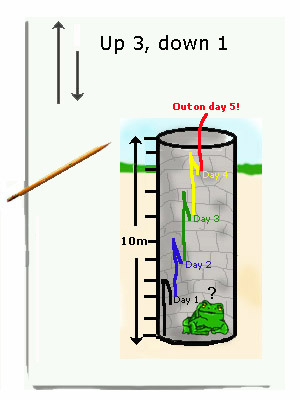
The draw a picture strategy is a problem-solving technique in which students make a visual representation of the problem. For example, the following problem could be solved by drawing a picture:

A frog is at the bottom of a 10-meter well. Each day he climbs up 3 meters. Each night he slides down 1 meter. On what day will he reach the top of the well and escape?

Why Is It Important?

Drawing a diagram or other type of visual representation is often a good starting point for solving all kinds of word problems. It is an intermediate step between language-as-text and the symbolic language of mathematics.

By representing units of measurement and other objects visually, students can begin to think about the problem mathematically. Pictures and diagrams are also good ways of describing solutions to problems; therefore they are an important part of mathematical communication.

How to Draw a Picture?

Encourage students to draw pictures of problems at the very beginning of their mathematical education. Promote and reinforce the strategy at all subsequent stages. Most students will naturally draw pictures if given the slightest encouragement.

Introduce a problem to students that will require them to draw a picture to solve. For example:

Marah is putting up a tent for a family reunion. The tent is 16 feet by 5 feet. Each 4-foot section of tent needs a post except the sides that are 5 feet. How many posts will she need?

Demonstrate that the first step to solving the problem is

understanding it.

This involves finding the key pieces of information needed to figure out the answer. This may require students reading the problem several times or putting the problem into their own words.

16 feet by 5 feet
1 post every 4 feet, including 1 at each corner
No posts on the short sides

Choose a Strategy

Most often, students use the draw a picture strategy to solve problems involving space or organization, but it can be applied to almost all math problems. Also students use this strategy when working with new concepts such as equivalent fractions or the basic operations of multiplication and division.

Solve the Problem

Students understand that there are posts every 4 feet. In the second sample problem,

students are asked to organize data spatially

to determine the number of posts Marah will need. They can draw a picture or a diagram to find the answer.I drew a rectangle where each long side is 16 feet, and there is 1 post every 4 feet. I drew a circle for each post. I remembered to draw a post at each end. There are 10 posts total.

Check Your Answer

Ask students to

read the problem again to be sure they answered the question.I found that there are 10 posts.

Students should check their math to be sure it is correct.16 divided by 4 is 4. There are 4 sections of 4 feet on each long side.
There is a post on each end, so 4 + 1 = 5. There are 2 sides to the tent, and 5 x 2 = 10. Discuss with students whether draw a picture was the best strategy for this problem. Was there a better way to solve it?Drawing a picture was a good strategy to use for this problem because students might forget to count the posts on each corner unless they see them.

Explain How You Found the Answer

Students should explain their answer and the process they went through to solve the problem.

It is important for students to talk or write about their thinking. There may be more than one way to represent a problem visually, and asking students to explain their picture helps to understand their thinking process and identify errors.

My answer is 10 fence posts.

First, I tried to solve this by multiplying. I took 16 and divided by 4 to find the number of posts on each side. I got 4 posts on each side. Then I doubled it to get 8 posts total. I checked the problem and realized that there are posts on each corner, so I drew a picture so that I could see it and be sure the answer was correct.I drew a rectangle to show the tent. Each long side is 16 feet, and there is 1 post every 4 feet, so I divided 16 by 4 to find out that there are 4 sections of 4 feet each. I drew a circle for each post, and wrote the number in the space between each post. I remembered to draw a post at each end. I counted the posts and found out that there are 10 posts total.

Guided Practice

Have students try to solve the following problem using the draw a picture strategy.Tai wants to frame a 3 x 5 picture surrounded by 2 inches of mat. How large will her frame need to be?Have students work in pairs, groups, or individually to solve this problem. They should be able to tell or write about how they found the answer as well as be able to justify their reasoning.

How Can You Stretch Students’ Thinking?

Some students are visual learners and work well when problems are illustrated or easy to see. Encourage students to draw pictures or diagrams for problems they find difficult. Encourage students to label all parts of their drawings. Students should understand that their drawings do not need to be perfect. Rather, their drawings need only represent the problem accurately and clearly show their thought processes.

Simplify the Problem -Problem Solving

How Simplify the Problem ?

Introduce a problem to students that is complex and might be easier to solve if it were simplified. For example:

On your way to visit a friend, you leave your house at 2:45 P.M. and travel 1 3/4 miles to the train, 12 1/2 miles on the train, and 3/4 mile to your friend’s house from the train station. If you get there at 4:15 P.M., how many miles per hour did you travel?

1. Understand the Problem

Demonstrate that the first step is understanding the problem.

This involves identifying the key pieces of information needed to find the answer.

Students may need to read the problem several times and/or put the problem into their own words.I know I left at a certain time, arrived at a certain time, and traveled a certain distance. I need to find how many miles per hour I traveled.

2. Choose a Strategy

For this problem, it might be helpful for students to use simpler numbers to learn the steps they need to follow to solve it.

Have students change the problem to:I left the house 1:00, traveled 12 miles, and arrived at 4:00. How many miles per hour did I travel?

3. Solve the Problem

First, have students solve the problem using the simpler numbers.I left the house 1:00, traveled 12 miles, and arrived at 4:00. How many miles per hour did I travel?
I traveled 12 miles.
It took 3 hours.
To find the miles per hour, I divide 12 by 3 to get 4 miles per hour.Next,

have them write down the steps they used to solve the problem.

Find the distance traveled.

Find the time spent.

Divide to find the miles per hour.Then, have them use the actual numbers from the problem and follow the same steps.

Find the distance traveled.
1 3/4 + 12 1/2 + 3/4 = 15 miles

Find the time spent.
The time from 2:45 to 4:15 is 1 hour and 30 minutes, or 1 1/2 hours.

Divide to find the miles per hour.
15 divided by 1 1/2 = 10 miles per hour

Crowdsourcing – problem solving

Crowdsourcing is the practice of utilizing the wisdom of a group for a common goal. It is best applied when attempting to solve complex problems in an innovative way or streamline intricate processes.

Let’s look at few key crowdsourcing ideas,

Crowd Contests

It is the easiest and most successful and most widely used technique to solve specific problems. Identify a problem, accept solutions, offer a reward and broadcast an invitation.

Good for: new product, product development, testing products, identifying issues, generating outside ideas

Where to run it: Social media websites, your site, independent landing pages, third party websites.

Collaborative Community

Just like Yelp and Amazon reviews, ask customers to review or compare your product with competitor products, encourage them by providing them badges or cash rewards for answering questions posed by customers.


Good for: Customers reviews, FAQ, sharing information, sharing and building knowledge.

Where to run it:  preferably on your website and social media sites.

Freelance Labor

Not all companies have experts in all the domains all the time, instead of hiring a new resource for a small project try to visit the third party intermediaries to find the right resources across the pool of professionals.

Good for: Short term projects, new technology ideation, data entry and validation.

Where to run it: Third-party intermediaries such as Elance, oDesk, Guru, Freelancer, and CloudCrowd

CrowdFunding

Crowdfunding is a powerful for running disaster relief campaigns, fundraising for a project, startup kickstart and ideations.

Good for: Product kickstart, new technology ideation, proof of concept

Where to run it: Third-party intermediaries such as Kickstarter, Gofundme, Indegogo.

In addition to organizing contests, engaging communities and hiring freelancers, companies can use can take a more internal approach to idea generation and creativity, like “jams,” idea marketplace and personal creative projects will increase the scope for innovation and exploration inside companies.

For centuries communities helped kick-start industries, what has changed now is technology. With the rapid grown of social media platforms and mobile phones crowdsourcing is easier, manageable and cost effective. As Steven Johnson said, “Innovation doesn’t come just from giving people incentives; it comes from creating environments where their ideas can connect.”